Jan. 16, 2025

One Homebuying Step You Don’t Want To Skip: Pre-Approval

One Homebuying Step You Don’t Want To Skip: Pre-Approval


There’s one essential step in the homebuying process you may not know a whole lot about and that’s pre-approval. Here’s a rundown of what it is and why it’s so important right now.

What Is Pre-Approval?

Pre-approval is like getting a green light from a lender. It lets you know how much they’re willing to let you borrow for a home. To determine that number, a lender looks at your financial history. According to Realtor.com, these are some of the documents a lender may ask you for during this process:

  • W-2s from the last two years
  • Tax returns from the last two years
  • Pay stubs from the last 30 days
  • Bank statements from the last 60 days
  • Investment account statements (if applicable)
  • Two years of history of where you’ve lived

The result? You’ll get a pre-approval letter showing what you can borrow. Keep in mind, that any changes in your finances can affect your pre-approval status. So, after you receive your letter, avoid switching jobs, applying for new credit cards or other loans, or taking out large sums of money from your savings.

How It Helps You Determine Your Borrowing Power

This year, home prices are expected to rise in most places and mortgage rates are still showing some volatility. So, since affordability is still tight, it’s a good idea to talk to a lender about your home loan options and how today’s changing mortgage rates will impact your future monthly payment.

The pre-approval process is the perfect time for that. Because it determines the maximum amount you can borrow, pre-approval also helps you figure out your budget. You should use this information to tailor your home search to what you’re actually comfortable with as far as a monthly mortgage payment. That way, you don’t fall in love with a house that’s out of your comfort zone.

How It Helps You Stand Out

Once you find a home you want to put an offer on, pre-approval has another big perk. It not only makes your offer stronger, it shows sellers you’ve already undergone a credit and financial check.

When a seller sees you as a serious buyer, they may be more attracted to your offer because it seems more likely to go through. As Greg McBride, Chief Financial Analyst at Bankrate, says:

“Preapproval carries more weight because it means lenders have actually done more than a cursory review of your credit and your finances, but have instead reviewed your pay stubs, tax returns and bank statements. A preapproval means you’ve cleared the hurdles necessary to be approved for a mortgage up to a certain dollar amount.”

Bottom Line

If you’re planning on buying a home, getting pre-approved for a mortgage should be one of the first things on your to-do list. Not only will it give you a better understanding of your borrowing power, it can put you in the best position possible to make a strong offer when you find a home you love. Connect with a trusted lender to learn more.


Posted in Home Buying
Jan. 15, 2025

Roughly 11,000 Homes Will Sell Today – Will Yours Be One of Them?

Roughly 11,000 Homes Will Sell Today – Will Yours Be One of Them?


Are you hesitant to sell your house because you’re worried no one’s buying with rates and prices where they are right now? Here’s some perspective that can help.

The market actually isn’t at a standstill. While there weren’t as many sales last year as there’d be in a normal market, roughly 4.15 million homes still sold (not including new construction), according to the National Association of Realtors (NAR). And the expectation is that number will rise in 2025. That means more people will likely move this year, and they need homes to buy. Homes like yours.

But even if we only match last year’s sales pace, here’s what that looks like.

Every Minute Homes Are Selling – Literally

  • 4.15 million homes ÷ 365 days in a year = 11,370 homes sell each day
  • 11,370 homes ÷ 24 hours in a day = 474 homes sell per hour
  • 474 homes ÷ 60 minutes = roughly 8 homes sell every minute

Think about that. Just in the time it took you to read this, 8 homes sold.

If you’ve been holding off on selling your house because you think buyers aren’t out there, let this reassure you – there are still buyers looking to buy.

Every day, thousands of people need to buy homes. So, while higher home prices and mortgage rates have slowed the market down and forced some buyers onto the sidelines, that doesn’t mean the market isn’t active. Many buyers are still eager to make a move because life doesn’t wait for perfect market conditions.

With the right agent by your side, you can get your house in front of those buyers while other hesitant homeowners are still putting their plans on pause because they’re worried buyer demand has disappeared. Let’s get your house sold.

Bottom Line

On average, over 11,000 homes sell every day, and yours could be one of them. In the time it took you to read this, another 8 homes sold.

When you’re ready to take the next step, let’s connect so you have an agent to create that perfect strategy.

Jan. 13, 2025

Home Prices Aren’t Declining, But Headlines Might Make You Think They Are

Home Prices Aren’t Declining, But Headlines Might Make You Think They Are


If you’ve seen the news lately about home sellers slashing prices, it’s a great example of how headlines do more to terrify than clarify. Here’s what’s really happening with prices.

The bottom line is home prices are higher than they were a year ago at this time, and they’re expected to keep rising, just at a slower pace.

But a recent article from Redfin notes,

“Price Drops Hit Highest Level in 18 Months As High Rates Dampen Buyer Demand.”

And that might make you think prices are declining.

Now, while it’s true the latest report from Realtor.com also shows 16.6% of homes on the market had price reductions in May, which is up from 12.7% last May, that doesn’t mean overall home prices are falling.

The key is knowing the difference between the asking price and the sold price.

Understanding Asking Price vs. Sold Price

In essence, the asking price, also known as a listing price, is the amount a seller hopes to get for their home when they list it. In reality, sellers can’t just put any price tag on their house and expect it to sell for top dollar. Today’s buyers are savvy customers, and when they aren’t willing to pay a premium for a home because their budgets are strained by higher mortgage rates, sellers need to adjust. And that’s what’s happening right now.

Based on market factors and what offers that seller receives, that asking price can change. If a seller isn’t getting much foot traffic, you may see them revise the price and make an adjustment to reignite interest in the home – and sometimes that’s because they’ve overpriced it from the start. That’s where price reductions come in, and when you see “price drops” in a headline, it sounds like declining home prices.

Mike Simonsen, CEO and Founder of Altos Research, says:

“Not only is the share of homes with price cuts elevated compared to one year ago, but more price cuts are happening each week than last year.”

On the other hand, the final sold price is the amount a buyer actually pays when the transaction is complete.

Here’s the most important thing to noteActual sold prices are still rising, and they’re expected to continue to do so at least over the next 5 years.

What Does This Mean for Home Prices?

So, while there's been an increase in price reductions recently, this doesn't mean overall home values are declining. Instead, it’s a sign that demand is moderating. And, as a result, sellers are adjusting their expectations to align with today's market reality.

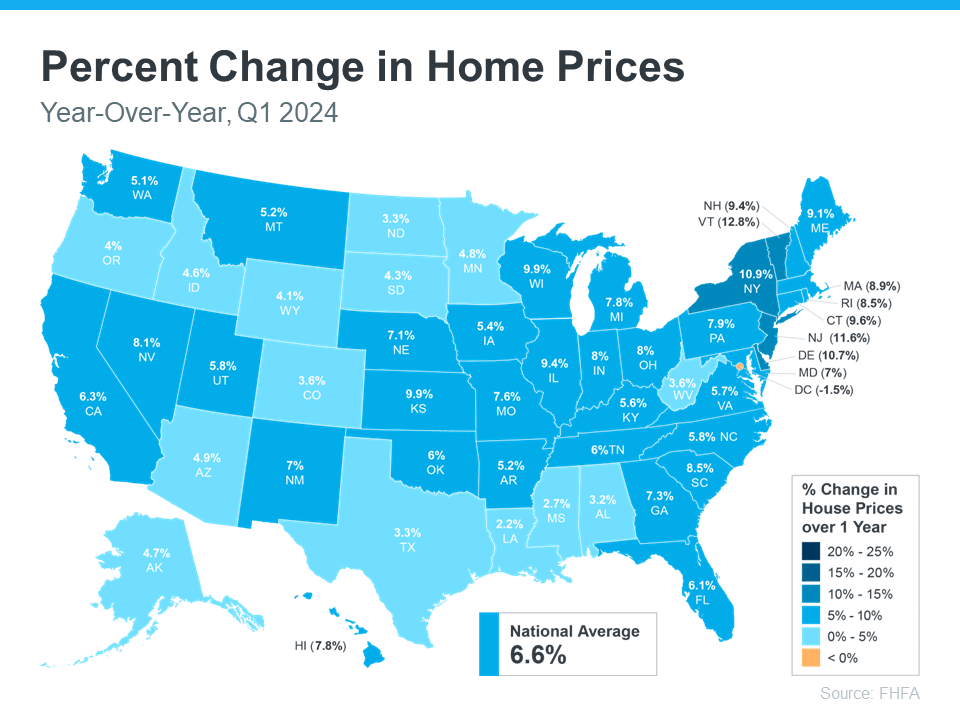
Even with more price reductions, home values are still growing on an annual basis, as they do nearly every year in the housing market. According to the Federal Housing Finance Agency (FHFA), home prices went up 6.6% over the last year (see below):No Caption Received

This map shows how prices rose just about everywhere in the country, indicating the market is not in decline.

So, while seller price reductions are often a leading indicator that prices may moderate in the months ahead, which experts have been saying for a while is expected to happen, they aren’t necessarily reason for alarm. The same article from Redfin also states:

“. . .those metrics suggest sale-price growth could soften in the coming months as persistently high mortgage rates turn off homebuyers. For now, the median-home sale price is up 4.3% year over year to another record high. . .”

And with inventory as tight as it is today, price moderation is much more likely in upcoming months than price declines.

Why This Is Good News for Buyers and Sellers

For buyers, more realistic asking prices mean a better chance of securing a home at a fair price. It also means you can enter the market with more confidence, knowing prices are stabilizing rather than continuing to skyrocket.

For sellers, understanding the need to adjust your asking price can lead to faster sales and fewer price negotiations. Setting a realistic price from the start can attract more serious buyers and lead to smoother transactions.

Bottom Line

While the uptick in price reductions might seem troubling, it’s not a cause for concern. It reflects a market adjusting to new conditions. Home prices are continuing to grow, just at a more moderate pace. 

Jan. 10, 2025

New Year, New Home: Real Estate Resolutions for 2025

New Year, New Home: Real Estate Resolutions for 2025

A couple achieving their real estate resolutions in 2025.

The new year often inspires fresh starts and bold decisions. For many, 2025 could be the year to take big steps toward buying, selling, or upgrading a home. Setting smart real estate goals early in the year can lead to exciting opportunities and meaningful progress. Let us explore practical and achievable resolutions for anyone navigating the real estate world this year.

1. Clarify Your Real Estate Goals

Begin with a clear vision. Are you looking to buy your first home, sell your current property, or invest in something new? Write down your goals and be specific. For example, you might aim to buy a three-bedroom house in a quiet neighborhood or sell your condo by summer. Knowing exactly what you want helps guide every decision.

2. Strengthen Your Financial Foundation

A strong financial position is essential in real estate. If you are looking to purchase, start by reviewing your credit score, as this will play an important role in securing financing. Aim to pay off lingering debts and build a solid savings account for a down payment, closing costs, and unexpected expenses. Setting a monthly savings target can make this less overwhelming.

3. Research the Market

Take time to learn about the real estate market in your area. Are prices rising or stable? Which neighborhoods are in demand? Understanding market trends helps you plan wisely and avoid surprises. Check online listings, attend open houses, and talk to local real estate agents to gain insights.

4. Build a Strong Support Team

Real estate can be tricky, so having the right people in your corner makes an enormous difference. Work with a trustworthy real estate agent who knows the local market well. You might also want to connect with a financial advisor, mortgage lender, and even a home inspector early on. A good team makes the process smoother and less stressful.

5. Declutter and Prepare Your Space

If selling your home is part of your 2025 plan, now is the time to start preparing. Decluttering can make your home feel larger and more inviting. Pack away items you do not use daily and consider freshening up spaces with neutral colors and modern touches. A little effort here can boost your home’s value and attract more buyers.

6. Explore Green Living Options

Sustainability is a growing trend in real estate. Adding eco-friendly features like solar panels, energy-efficient windows, or smart thermostats can save money and attract environmentally conscious buyers. If you are buying, look for homes with these features or plan upgrades for the future.

7. Learn the Art of Negotiation

Negotiating is a key part of real estate, whether you are buying or selling. Practice confidently asking for what you need, whether it is a better price, extra repairs, or extended timelines. Collaborating closely with your agent can help you set strategies or make smart offers to achieve your real estate goals.

8. Focus on Location and Lifestyle

A home is more than its walls and roof. Think about the lifestyle you want in 2025. Do you dream of a shorter commute, living near good schools, or having access to parks and shopping? Finding the right location can enhance your daily life and make your investment more rewarding.

9. Plan for Long-Term Growth

Real estate is a long-term commitment. Before making decisions, think about how your needs might change over the next five or ten years. A growing family, remote work, or retirement plans can all affect the type of home that is best for you. Thinking ahead helps you avoid costly mistakes.

10. Stay Flexible and Open-Minded

The real estate market can be unpredictable. Staying flexible allows you to adapt to changes and find unexpected opportunities. For example, you might fall in love with a home slightly outside your target area or discover a fixer-upper with immense potential.

11. Use the New Year as Motivation

The start of the year is the perfect time to take action. Make a timeline for your goals and commit to checking off steps each month. Staying organized and motivated will keep you on track and help you reach your real estate dreams.

12. Celebrate Small Wins

Every step forward is a reason to celebrate. Found a great agent? That is a win. Improved your credit score? Another win. Recognizing progress keeps the process enjoyable and encourages you to keep going, even when things feel challenging.

13. Think Beyond the Sale or Purchase

Real estate is about creating a home and lifestyle, not just completing a transaction. Whether it is your first house, an upgrade, a downsize, or investment property, focus on making it a space where you and others will thrive. Consider how you can personalize it to reflect your style and meet your needs. If it is an investment property, think about how you can set it up conveniently for tenants or short-term guests.

14. Keep Learning About Real Estate

The more you know, the better decisions you will make. Read articles, attend workshops, or listen to podcasts about real estate. Learning does not have to be boring—it is a way to empower yourself for the journey ahead.

15. Make 2025 the Year You Act

Real estate dreams do not come true overnight. Taking steady, thoughtful steps will make a dramatic difference by the end of the year. Whether you are ready to buy, sell, or invest, now is the time to turn those plans into reality.

Conclusion

As the new year begins, let this be the moment you commit to your real estate resolutions. With focus, preparation, and the right mindset, 2025 can be your most exciting year yet in the real estate world.

Posted in Home Buying
Jan. 6, 2025

Time in the Market Beats Timing the Market


Time in the Market Beats Timing the Market


Trying to decide whether it makes more sense to buy a home now or wait? There’s a lot to consider, from what’s happening in the market to your changing needs. But generally speaking, aiming to time the market isn’t a good strategy – there are too many factors at play for that to even be possible.

That’s why experts usually say time in the market is better than timing the market.

In other words, if you want to buy a home and you’re able to make the numbers work, doing it sooner rather than later is usually worth it. Bankrate explains why: 

“No matter which way the real estate market is leaning, though, buying now means you can start building equity immediately.” 

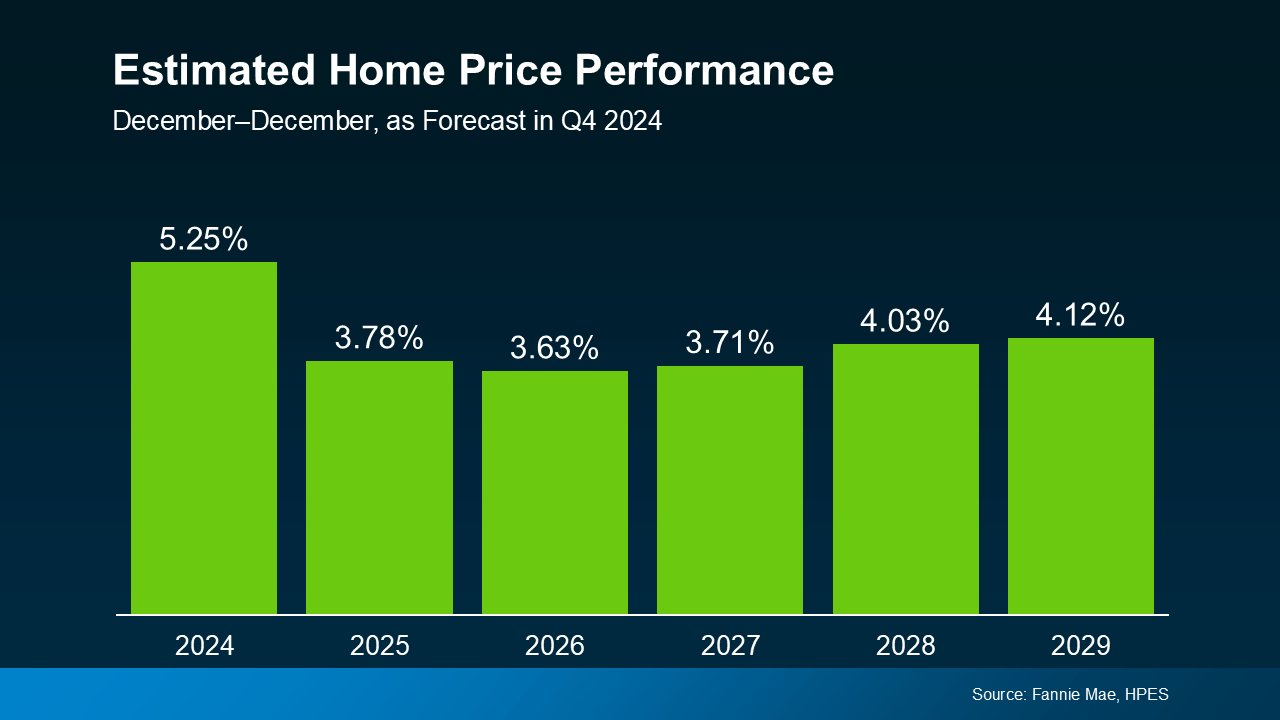
Here’s some data to break this down so you can really see the benefit of buying now versus later – if you’re able to. Each quarter, Fannie Mae releases the Home Price Expectations Survey. It asks over one hundred economists, real estate experts, and investment and market strategists what they forecast for home prices over the next five years. In the latest release, experts are projecting home prices will continue to rise through at least 2029 – just at a slower, more normal pace than they did over the past few years (see the graph below):

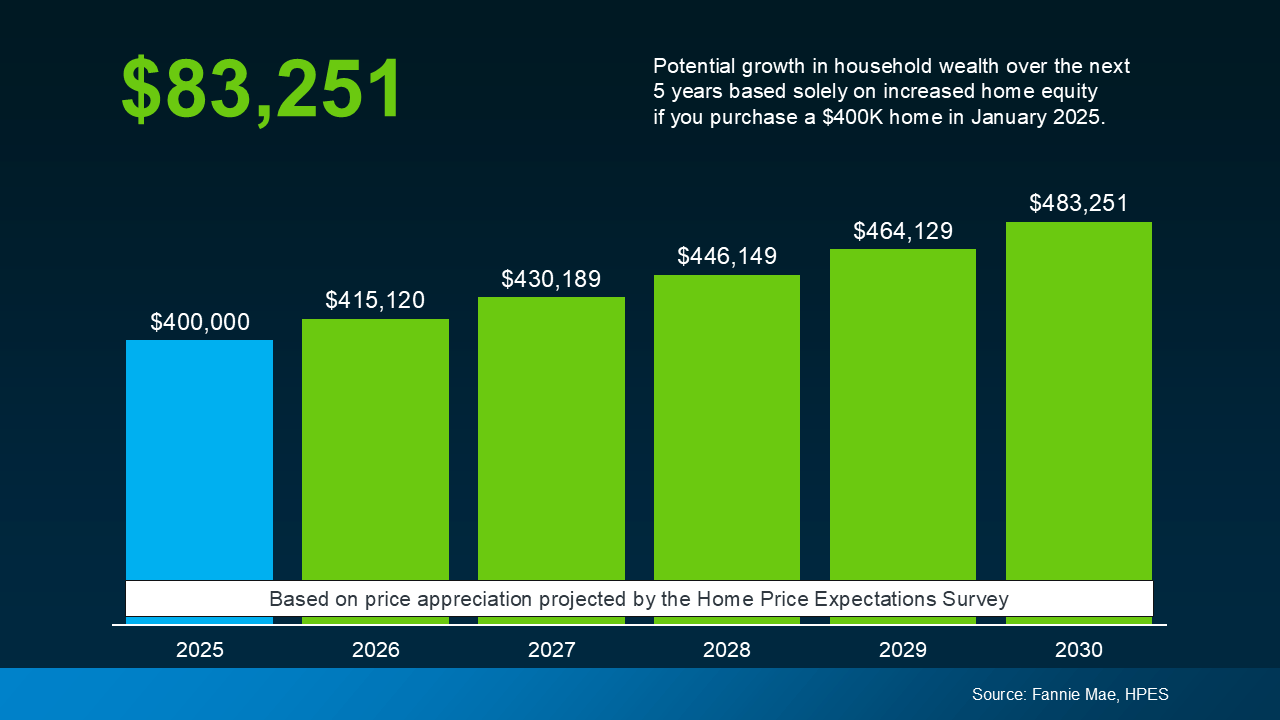
a graph of a number of green rectanglesBut what does that really mean for you? To give these numbers context, the graph below uses a typical home value to show how it could appreciate over the next few years using those HPES projections (see graph below). This is what you could start to earn in equity if you buy a home in early 2025. 

a graph of growth of a houseIn this example, let’s say you go ahead and buy a $400,000 home this January. Based on the expert forecasts from the HPES, you could gain more than $83,000 in household wealth over the next five years. That’s not a small number. If you keep on renting, you’re losing out on this equity gain.

And while today’s market has its fair share of challenges, this is why buying is going to be worth it in the long run. If you want to buy a home, don’t give up. There are creative ways we can make your purchase possible. From looking at more affordable areas, to considering condos or townhomes, or even checking out down payment assistance programs, there are options to help you make it happen.

So sure, you could wait. But if you’re just waiting it out to perfectly time the market, this is what you’re missing out on. And that decision is up to you.

Bottom Line

If you’re torn between buying now or waiting, don’t forget that it’s time in the market, not timing the market that truly matters. Let’s connect if you want to talk about what you need to do to get the process started today.

Posted in Home Buying
Dec. 31, 2024

Simple Steps To Help You Save for Your First Home

Simple Steps To Help You Save for Your First Home


Turning a dream into reality starts with one thing: a plan. And if buying your first home is on your list of goals, now’s the perfect time to put a plan in motion to help you save.

And the best part? Reaching your savings goal doesn’t mean making huge sacrifices overnight – small, consistent steps can get you there over time. Here are a few strategies that can help speed up the process.

Step 1: Build a Budget That Works for You

Knowing where your money’s going is the first step to saving more of it. Take some time to track the money you’ve got coming in and going out. This helps you spot areas where you're spending more than you realize. It also helps to give yourself some guidelines on what you want to spend for groceries, gas, and more – try to stick to whatever caps you put on each spending category.

Step 2: Cut Down on Any Extras (It Adds Up)

Once you’ve got a clear budget, it’s time to tighten up. Look for areas where you can cut down your costs – like services you don’t really need – or ways you can reduce recurring expenses and put that money in your house fund instead. Every dollar you save now brings you closer to your future house. As Bankrate says:

If you’re saving for a house, cutting back on your spending can help. Start with cutting unnecessary expenses, like subscription services, entertainment, delivery services or eating out. If possible, negotiate down recurring monthly or annual expenses, such as getting a better car insurance rate or reducing an internet bill . . . .”

Step 3: Automate Your Savings

Consistency is the real game-changer. If you have to transfer money manually, you may forget to do it. That’s why setting up automatic transfers to a dedicated savings account makes it easier to save regularly. Even apps that round up purchases to the nearest dollar and save the difference can help you build momentum without effort. As an article from Forbes explains:

Automating your savings helps to keep your progress toward your goal consistent. Set up automatic transfers from your checking account to a dedicated savings account. This will help you prioritize saving and minimize the chances of spending your money on other things.”

Step Four: Put Any Extra Money To Work

Got a tax refund, work bonus, or a cash gift? Don’t fall into the temptation to spend it on something you don’t actually need. Use those unexpected boosts to make big strides toward your savings goal. Treating this extra cash as an opportunity, not just a nice surprise, will help you get there faster.

Bottom Line

Saving for your first house isn’t about perfection – it’s about progress. A solid plan, a little discipline, and a clear goal will take you further than you think. If you’re ready to make homeownership happen, let’s connect. We’ll map out the next steps together to get you closer to the keys to your first home.

Posted in Home Buying
Dec. 28, 2024

What’s Motivating More Buyers To Choose a Newly Built Home?

What’s Motivating More Buyers To Choose a Newly Built Home?


Planning to buy a home soon? Why not go for something brand-new? Because data shows a lot more buyers are seeing the appeal of new home construction these days – and you may find out it’s what you want too.

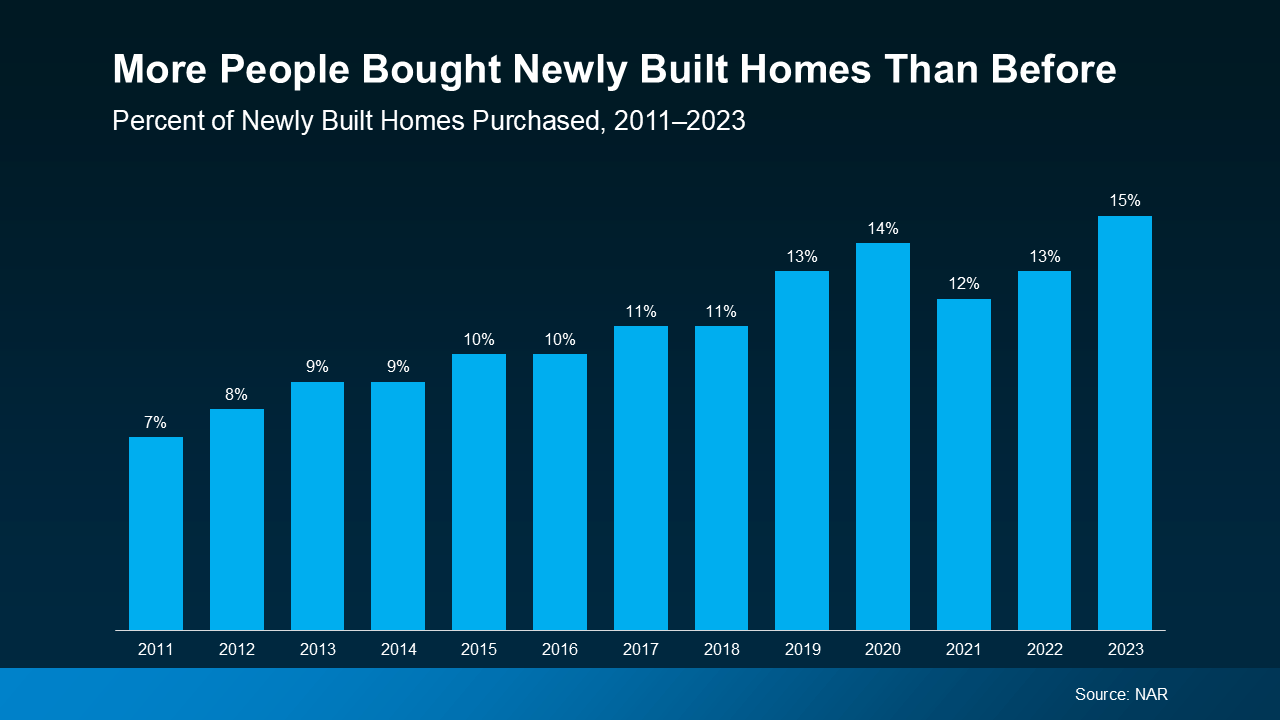
The National Association of Realtors (NAR), explains that newly built homes accounted for 15% of all homes sold last year. That’s a significant increase, and is actually the highest percentage in 17 years (see graph below):

a graph of blue barsTo get a closer look at why so many people are opting for a brand-new home, NAR surveyed recent buyers. And here are the top reasons why new builds gained so much popularity (see graph below):

a graph of blue squares Avoiding Renovations or Problems with Plumbing or Electricity (42%)

According to buyers, the number one benefit is the peace of mind that comes with getting brand-new everything. Because let’s face it, buying a home right now is pricey. And with inflation also putting a pinch on your wallet, you want to do everything you can to cut down on any additional costs. Enter new builds.

A home that was just built is less likely to have unexpected repairs, and that means less maintenance you’ll need to budget for upfront. Plus, since many builders include warranties on their homes, that’s an added layer of protection for your wallet on some of the home’s major systems.

Ability To Choose and Customize Design Features (27%)

You may also get the chance to personalize parts of the build to your unique tastes. That can be as small as which knobs go on the cabinets and which light fixture goes in the dining room to as big as floor plans and siding color. So, if you’re not finding a home you like, it may be time to build one.

The Amenities of New Home Construction Communities (25%)

Many new developments also offer amenities like parks, pools, fitness centers, and community spaces. These features could help you feel more connected to your neighborhood and can be a great perk for your lifestyle.

Lack of Inventory of Previously Owned Homes (15%)

Since the supply of existing homes (homes that were previously lived in) is still lower than the norm, more people are asking their agents if they can see what builders have available – and builders aren’t disappointing. Right now, new builds make up a larger portion of the homes available for sale than the norm. So, checking out these homes can really open up your pool of options. And don’t worry – builders are not overbuilding. They’re just catching up after years of underbuilding.

Energy Efficiency (14%)

Not to mention, newly built homes usually have the latest energy-efficient materials and technologies. This not only feels good, but can also lead to lower utility bills and a reduced environmental footprint. In a U.S. News Real Estate interview with Kevin Morrow, Senior Program Manager at the National Association of Home Builders (NAHB), this topic came up:

“The more energy-efficient mechanics of the house also help reduce utility bills for new home buyers . . . Newly-constructed homes often include green systems and appliances—like high efficiency stoves, refrigerators, washing machines, water heaters, furnaces, or air conditioning units—that homes built years ago might not.”

Smart Home Features (11%)

And last on this list is the integration of smart technologies. Tech-savvy buyers often want the latest and greatest advancements – and new home construction usually delivers.

The Importance of Using Your Own Agent

Newly built homes are becoming a top pick for buyers these days, and it’s easy to see why. If you’re feeling motivated to see what’s out there, just remember you need to have your own real estate agent.

Builder contracts often have some complex terms and complicated fine print. If you bring your own agent, you’ll have someone to advocate for you, make sure you’re getting quality construction, and guide you through the process from start to finish. 

Bottom Line

Imagine skipping the hassle of renovations and having the freedom to pick out the exact design features you want. If this sounds good to you, let’s connect to make sure you’ve got your own agent to help you negotiate with the builder so you can buy a new home with confidence.

Posted in Home Buying
Dec. 17, 2024

More Starter Homes Are Hitting the Market

More Starter Homes Are Hitting the Market


More entry-level homes – also known as starter homes – are popping up on the market. And after several years with very few homes available to buy and prices rising, there are finally some more options for first-time buyers.

Inventory Is Increasing – Especially at Lower Price Points

Over the past year, the total supply of homes for sale has improved. According to Realtor.com, in November there were 26.2% more homes for sale compared to this time last year, marking 13 months of inventory growth and the most homes available since December of 2019.

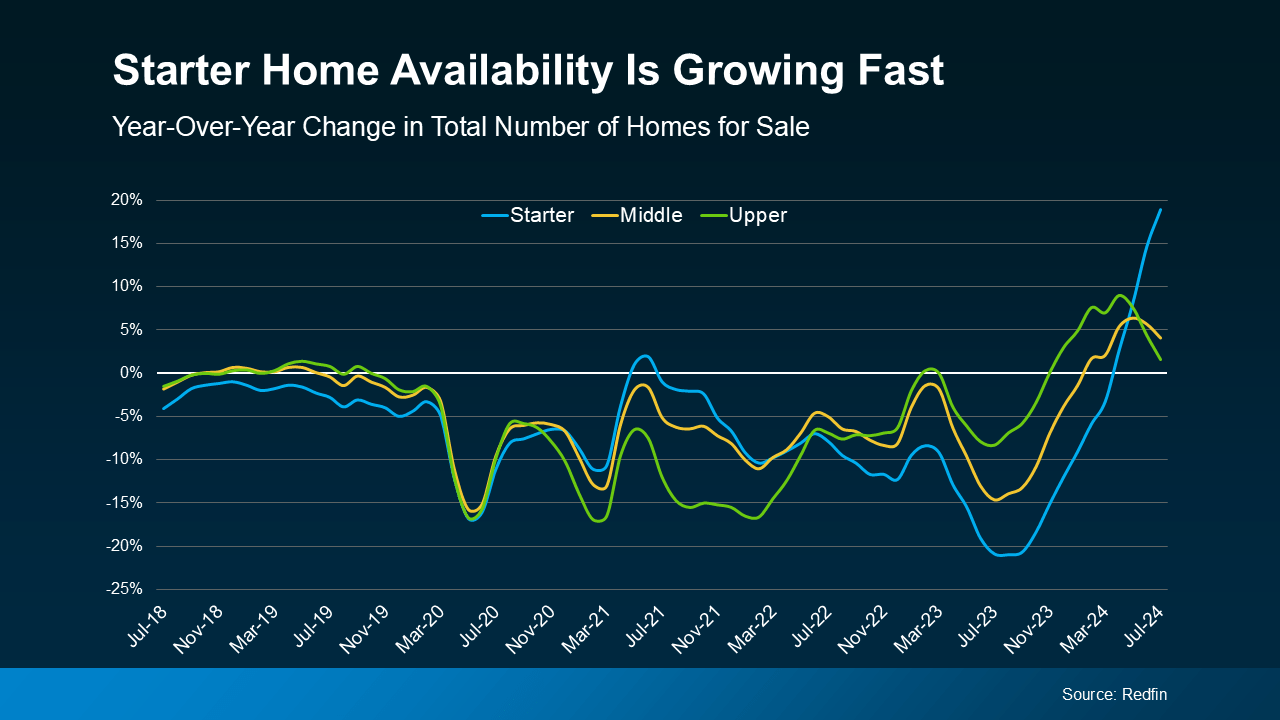
Interestingly, the growth isn’t spread evenly among all types of homes, though. According to Redfin, starter homes have seen the biggest increase (see graph below):

a graph of a number of homesSo, if you’re a first-time buyer who’s been sitting on the sidelines waiting because you thought you might never find a starter home in your market, this could be a game-changer. You finally have more options to choose from, and you just might be able to find one in your price range.

How an Experienced Agent Helps You Find a Starter Homes

Finding the right starter home at the right price point in your local market might feel like an unthinkable challenge, but a local real estate agent makes it easier. They stay up to date on the latest starter home listings in your area, so you don’t miss any opportunities.

Your agent will help you focus on homes that match your budget and your needs, making the search less stressful. They’ll also guide you through how to make the right offer and negotiate to get the best outcome possible.

On top of that, they handle the important details, like documentation and deadlines, so you can stay right on track. And if you have questions, your agent is there with answers and expert advice every step of the way.

Bottom Line

Starter homes are making a bit of a comeback, and this could be your chance to find one. Whether you’re ready to visit listings, need advice, or just want to see what’s out there, let’s connect.

Posted in Home Buying
Dec. 16, 2024

Only an Expert Agent Can Give You an Accurate Value of Your Home

Only an Expert Agent Can Give You an Accurate Value of Your Home


In today’s digital age, it’s tempting to rely on automated tools for everything — including figuring out how much your house is worth. But be careful. The automated estimates you’re seeing online often miss key details that affect the true market value of your home.

Before you toss a for sale sign in your yard and expect to bring in the number you saw for your house online, you need to understand why these tools generally aren’t spot-on and why working with an expert real estate agent is the best way to get an accurate picture of what your house is really worth.

The Myth: Online Home Value Estimates Are Accurate

Online home valuation tools give you an approximate value for your house based on the data that’s publicly available for your home. While this can give you a rough starting point, the keyword here is rough. As an article from Ramsey Solutions says:

“Online Home Value Estimators Aren’t 100% Accurate . . . The estimates are only as reliable as the amount of public record data the real estate websites can access. The less data gathered for your particular neighborhood, county and state, the less you can depend on this number.”

The Reality: Online Estimates Miss Key Factors

Here’s the biggest issue with online estimates: they don’t take into account the unique aspects of your home or your local market. And that’s why an agent’s expertise can make such a difference when figuring out what your house is really worth. Here’s an example. A real estate agent will also factor in:

  • The Home’s Condition: Online tools can’t tell whether your home has been well-maintained or if it needs significant repairs. The condition of your house plays a huge role in its value, and only an in-person walk-through can account for that.
  • The Latest Neighborhood Trends: Is your neighborhood up-and-coming? Are there new developments or amenities nearby that make your home more desirable? Automated tools often overlook local trends that can significantly affect the value of your home.
  • Accurate Comparable Sales: While online estimates may use past sales data as a baseline, they don’t always reflect the most recent or most relevant comparable sales, or comps. Real estate agents, on the other hand, have access to up-to-date market data and can give you a much more accurate estimate based on real-time sales in your area.

Agents have a deep understanding of the local market, and they can provide insights that automated tools simply can’t match. As Bankrate explains:

“Online estimation tools determine pricing using algorithms that rely on publicly available information. These algorithms can vary widely from one tool to the next and typically don’t account for a home’s current condition or any upgrades or renovations that are not reflected in public records. So they are not as accurate as in-person methods, like a real estate agent’s comparative market analysis . . .”

Bottom Line

While online home value estimates can be a helpful tool to get a rough idea of what your home is worth, they aren’t foolproof. The true value of your home depends on a range of factors that automated tools just can’t account for.

To get the most accurate estimate, let’s connect. That way you have expert guidance and up-to-date market insights to set the best possible price for your home. 

Posted in Home Buying
Dec. 11, 2024

Why Moving to a More Affordable Area Makes Sense

Why Moving to a More Affordable Area Makes Sense


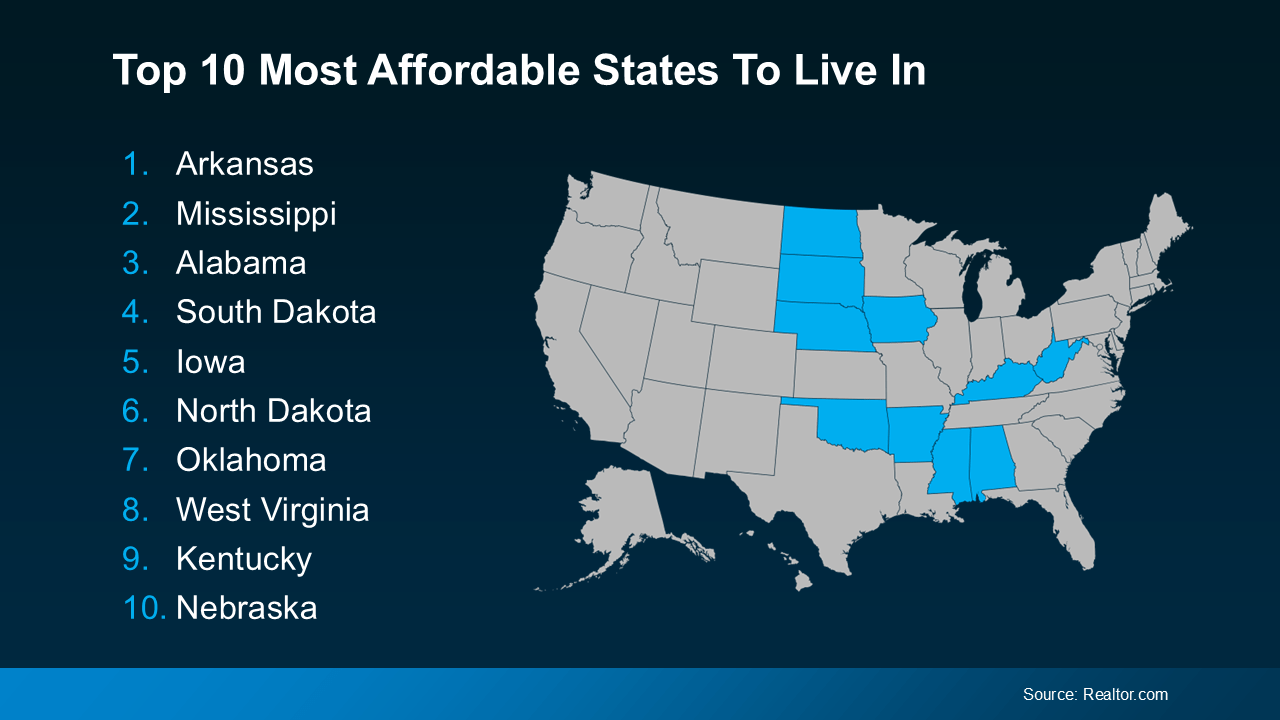
Moving to a more affordable area could be the fresh start you need to get ahead financially. While some markets are certainly more affordable than others, know that working with a trusted real estate agent to find what fits your budget and your desired location – no matter where you want to be – is always the best plan. And with the rising cost of living, many people are rethinking where they live and looking for ways to cut expenses. If that sounds like you, here’s a great place to start (see visual below):

a map of the united statesThese states are well known for lower housing costs, reduced insurance premiums, and more budget-friendly daily living expenses – but they’re not the only places to find a hidden gem. If you're open to relocating, you might discover the savings you’re looking for.

Why Move to a Lower-Cost Area?

Life is getting more expensive by the day. From rising home prices to higher grocery bills, it feels like everything costs more than it used to. Housing, the largest expense for most people, has become especially costly.

In fact, according to data from Case-Shiller, home prices increased 3.9% from September 2023 to September 2024. And data from GOBankingRates shows insurance costs are up too, with home insurance premiums averaging $2,151 annually – a significant jump compared to recent years.

These rising costs can feel like a lot to handle. That’s why more people are considering lower-cost areas. An article from the National Association of Realtors (NAR) says:

"With the past decade of rising home prices, buyers are looking for more affordable areas . . . As housing affordability continues to shape migration patterns, these areas may provide an opportunity . . . for those looking for more cost-effective alternatives to the nation’s larger, pricier metropolitan areas."

Lower-cost areas typically offer more affordable housing, less expensive home insurance, and reduced costs for daily living like groceries and gas. Transportation expenses and car insurance premiums also tend to be lower. For anyone feeling stretched thin, moving to a less expensive area can provide meaningful financial relief.

Planning Your Big Move

Whether it’s finding a home that fits your budget or cutting down on other expenses, making the right move in any market can bring significant financial relief. Of course, moving isn’t a decision to take lightly.

Whether you’re moving just a few towns over or to a completely different state, there’s a lot to consider. From job opportunities, to schools, to local amenities – it all has an impact on finding the right home for you.

This is where a knowledgeable local real estate agent can be your best resource. Not only can they help you navigate the housing market in your new or desired area, but they’ll also guide you to neighborhoods that balance affordability with your needs.

And don’t worry if none of the states on the affordability list seem like the right fit for you. An agent can still help you identify budget-friendly options wherever you need to be.

Bottom Line

If the rising cost of living has you feeling stuck, know that you have options. Moving to a more affordable area could be the fresh start you need to get ahead financially and improve your quality of life.

But don’t try to tackle the process alone. With the help of a real estate agent who knows the area, you’ll be well-prepared to make a move. When you’re ready to take the first step, let’s connect.