June 3, 2026

The Mid-Year Housing Market Update: Why Forecasts Changed in 2026

The Mid-Year Housing Market Update: Why Forecasts Changed in 2026


If the housing market feels confusing right now, you’re not alone.

Mortgage rates have risen. Home sales haven't picked up like expected. And many buyers and sellers are wondering when things are going to feel easier or be more affordable.

The truth is: a lot changed over the first half of this year.

Back at the end of 2025, economists were forecasting a much stronger housing market for 2026. They expected mortgage rates to come down, affordability to improve more dramatically, and home sales to rebound.

But lingering inflation, economic uncertainty, and growing geopolitical tensions overseas pushed mortgage rates higher than expected. And because rates stayed elevated for longer, many buyers continued to hold off.

That’s why experts recently revised their housing forecasts for the rest of the year (see graph below):
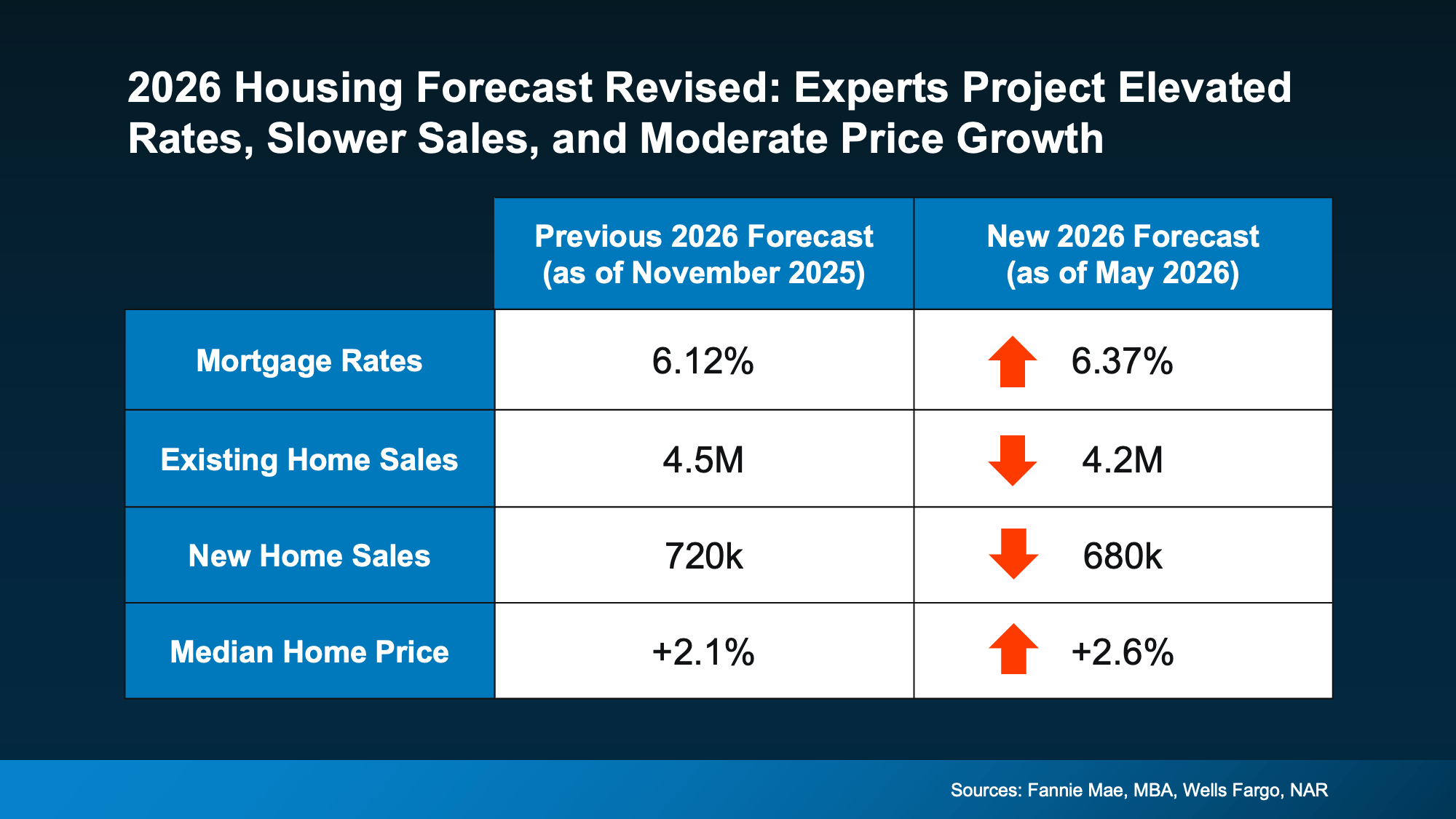
a graph of sales and sales

So, what does this actually mean for you? Let’s break it down.

Mortgage Rates May Remain Elevated

While just about everyone wants mortgage rates to go back to the uppers 5s or low 6s we saw at the start of the year, as of right now, the experts don’t think that’s likely to happen this year.

Instead, forecasts have been updated from the low 6s they originally projected. Many industry organizations are saying rates will stay in roughly the mid 6s this year. The good news is, that’s still lower than rates were a year ago.

Of course, this is based on what we know today. If the conflict overseas comes to an end or inflation drops, this could change. But if you’re waiting for lower rates, it may not pay off in the way you expect.

Existing Home Sales Revised Lower

Back in late 2025, experts expected we’d sell an average of 4.5 million homes this year. Now? That’s dropped down a bit to 4.2 million.

That tells us something important: buyers are still hesitant because affordability remains challenging.

Higher mortgage rates have made monthly payments harder to manage, especially for first-time buyers. And that’s slowed the pace of the market compared to what was originally expected. But even though the forecast was revised down, we’re still expected to sell more homes than last year. 

Once geopolitical tensions resolve and rates begin to settle down, many experts believe that group of buyers will be ready to jump back in. As Lawrence Yun, Chief Economist at NAR, explains:

“There is sizable pent-up demand that could be released into the market.”

There has already been a few glimmers of renewed hope lately. In recent months, pending homes sale have been improving month-over-month despite higher rates.

So, if you’re able to afford a home at today’s rates, it could still make sense to buy now. Because otherwise, if you wait, you’ll have more competition (and potentially fewer homes to choose from) when those others buyers jump back in.

New Home Sales Also Slowed

Builders also expected to have a stronger year. Earlier forecasts projected new home sales would top 700k in 2026. Now, economists expect we'll be just shy of that number.

Again, mortgage rates are a major reason why.

But the upside for buyers is that builders may be even more motivated to sell. That means builder incentives, negotiation opportunities, and pricing flexibility may continue in many markets. So, if you live somewhere where there’s more new construction, this may actually be a bright spot for you.

Builders could be more ready to negotiate, and that gives you more leverage to get a better deal.

Home Prices Are Still Expected To Rise

This is one of the most important takeaways from the entire forecast. Even though sales activity is slower, on average, experts did not revise their home price forecast downward.

They still expect prices to rise nationally this year.

Why? Because while buyer demand has softened, the number of homes for sale is still relatively limited overall. That imbalance is helping support prices, even in a slower market.

Of course, conditions vary depending on where you live. Some markets are cooling more than others. But nationally, experts are still projecting steady price growth — not a major decline. And that should be a comfort whether you’re buying or selling.

Because sellers don’t want a major drop in prices. And while buyers may think they do, generally you feel better about a big purchase when it doesn’t depreciate right away.

Bottom Line

The housing market hasn’t rebounded as quickly as experts originally hoped. But that doesn’t mean it’s stalled.

Higher inflation and lingering economic uncertainty caused economists to revise their forecasts for this year. But importantly, when those two things settle down, many experts believe the market will regain its momentum.

So don’t see this revision in forecasts as a sign of trouble. See it as a temporary reaction to overall conditions and uncertainty.

If you want to know what’s happening in our local market, and what it could mean for your plans for the rest of this year, let’s connect.

Posted in Home Buying
June 1, 2026

Less House, More Home: Why Smaller Homes Are Paying Off for Today’s Buyers

Less House, More Home: Why Smaller Homes Are Paying Off for Today’s Buyers


You started shopping with a specific mental image of your future home in your mind. Then the houses in your budget came in smaller than you pictured.

That’s the reality for a lot of buyers right now. Affordability is tight.

But don’t let that discourage you. Going smaller might actually be a smart play in today’s market – and the upside can be bigger than you'd think. Let’s break down two places to look where smaller won’t necessarily feel like a compromise.

Homebuilders Are Focused on Smaller Options Lately

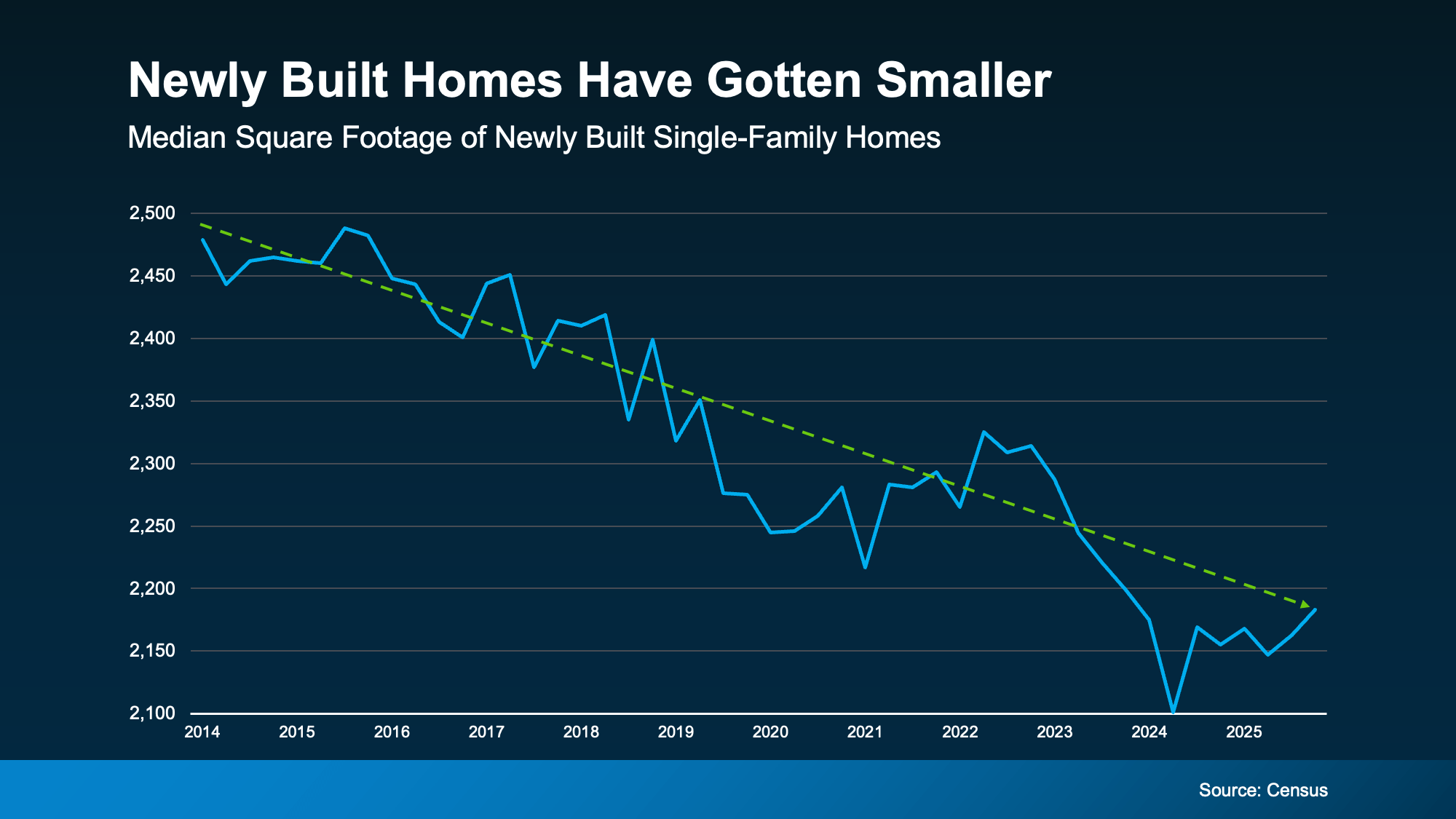
For starters, smaller is kind of on trend right now. Newly built homes have been shrinking for years. According to the latest data from the Census, the median square footage of new single-family homes has been falling overall since 2014 (see graph below):

a graph of a graph showing a line of a house

Why? Builders focus on the types of homes consumers want the most. After all, they want to build what will actually sell. And for the past decade, buyers seem to agree less is more.

Especially right now, when affordability is a key concern, they’re building homes with smaller square footage than a decade ago. And that’s good because that may be more within budget for many buyers. It’s part of why new home prices recently hit a 5-year low.

So, if you’re not getting excited about any of the existing options at your price point, it may be time to check out what builders are doing in your area.

You may find brand-new options you really love with all the latest and greatest features. And if you’ve got modern appliances and design, maybe slightly less square footage doesn’t feel like that much of a compromise anymore, especially if the house is move-in ready.

Condos Are Opening Up Another Path

Just in case you don’t have a ton of new builds in your area, another avenue worth exploring is condominiums or condos.

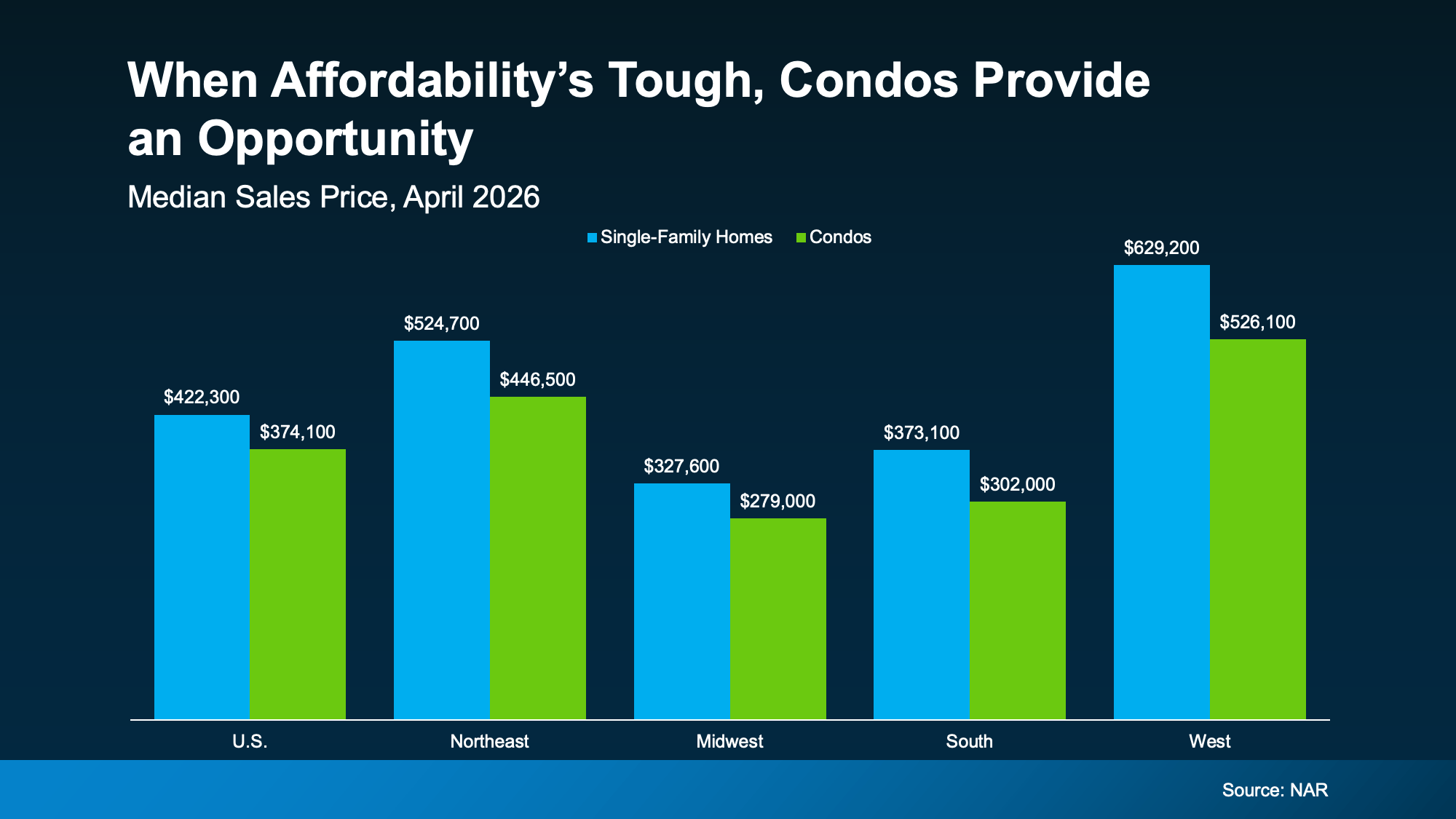
For buyers crunching numbers to make the math work, condos can take real pressure off the budget. According to the National Association of Realtors (NAR), the median price for condos is less than the median for single-family homes in every region (see graph below):

a graph of a number of blue and green bars

Part of that is because condos are typically smaller. And smaller square footage can come with a smaller price tag too. That's a selling point to affordability-strapped buyers right now – and it’s one of the reasons we’re seeing a bump in condo sales.

The number of condos sold rose 2.7% from just a month ago. It’s also up year over year, according to NAR. Ali Wolf, Chief Economist for New Home Source, explains why more buyers are going this route:

“In addition to favoring smaller floor plans, more consumers are showing a willingness to live in an attached home. This shift is not driven by a preference for shared walls, but by a pursuit of value.”

The Community Does Some of the Heavy Lifting

Here’s why smaller may still work for you. Whether it’s a condo complex or a neighborhood of detached single-family homes, the right community can give you back in amenities what you trade in square footage.

Many developments are designed so the home is just one piece of where you actually spend your time. Master-planned communities often include walking trails, pools, fitness centers, co-working spaces, and outdoor gathering areas – the kind of features that pick up where your floor plan leaves off.

No room for a dedicated office? The co-working space might be just a five-minute walk away. Want a place to work out? It's already built in with the shared gym. And features like that can make opting for a smaller footprint feel less like a compromise – and more like a big lifestyle upgrade.

Bottom Line

Today’s smaller single-family homes and condos have more going for them than the square footage suggests. They can give your budget some breathing room and put you in a community designed with lifestyle in mind.

Curious about the options in our area? Let's connect.

Posted in Home Selling
May 28, 2026

The Real Reason Some People Are Still Moving Right Now

The Real Reason Some People Are Still Moving Right Now


You may be telling yourself you’re going to wait to move – maybe you’re hoping mortgage rates will come down, prices will fall, or the market will feel a little easier.

And honestly? A lot of people feel that way right now. But here’s what some are starting to realize.

Waiting doesn’t usually fix the thing that made you want to move in the first place.

Your family still desperately needs more room. Your empty nest still feels too...empty.

Your parents or grandparents still need you to live closer.

You just got married... or divorced.

Your vision of retirement has you living somewhere else.

Eventually, life can reach a point where waiting feels harder than moving.

That’s why some people are still deciding to buy right now, even in today’s market. Not because conditions are perfect. But because the life changes behind their move never really went away.

And maybe that’s exactly where you are too. If so, you’re certainly not alone.

The Real Reasons People Move 

Data from the National Association of Realtors (NAR) shows 1 in 5 buyers last year said they felt like they had to purchase a home at that time, no matter the market.

That's an important reminder right now. Sure, the dollars and cents of your move have to make sense for you. But big life changes happen whether mortgage rates and home prices are high, low, or somewhere in between. 

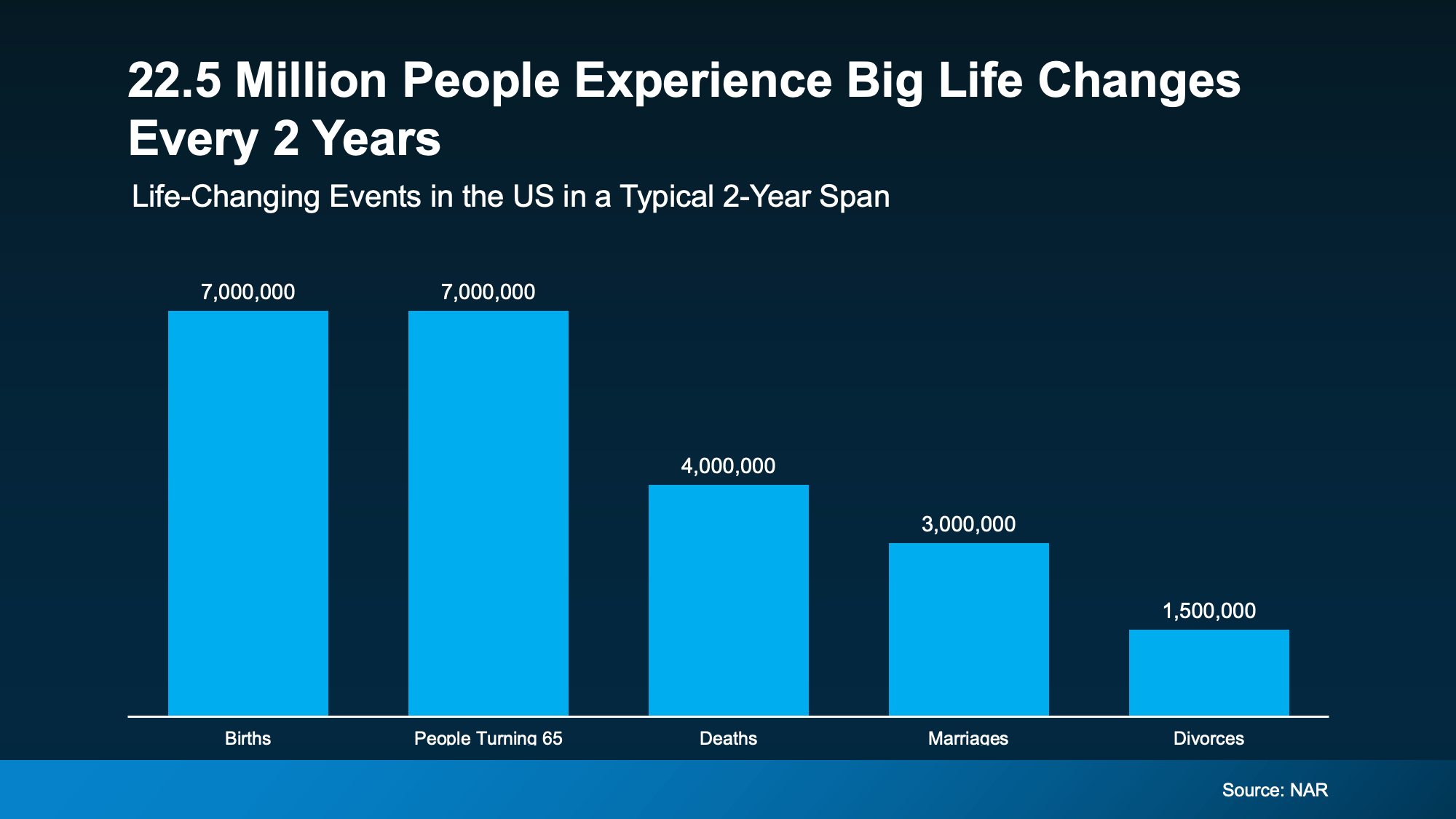
And those big life events happen more than you may think. NAR says roughly 22.5 million people experience major life changes in a typical two-year span (see graph below):

a graph of blue rectangular objects

These are exactly the kinds of things that can change how much space you need, where you want to live, or what kind of lifestyle makes sense now. Chen Zhao, Head of Economics Research at Redfin, explains:

“Life doesn’t stand still—people get new jobs, grow their families, downsize after retirement, or simply want to live in a different neighborhood.”

And that’s what makes waiting so hard. Every month you spend hoping the market changes is another month living in a house that no longer works for your life. It’s stressful to feel stuck. And that feeling usually doesn’t disappear.

There May Be More Opportunity Than You Think

But while affordability is still a challenge, there may still be a way for you to make your move.

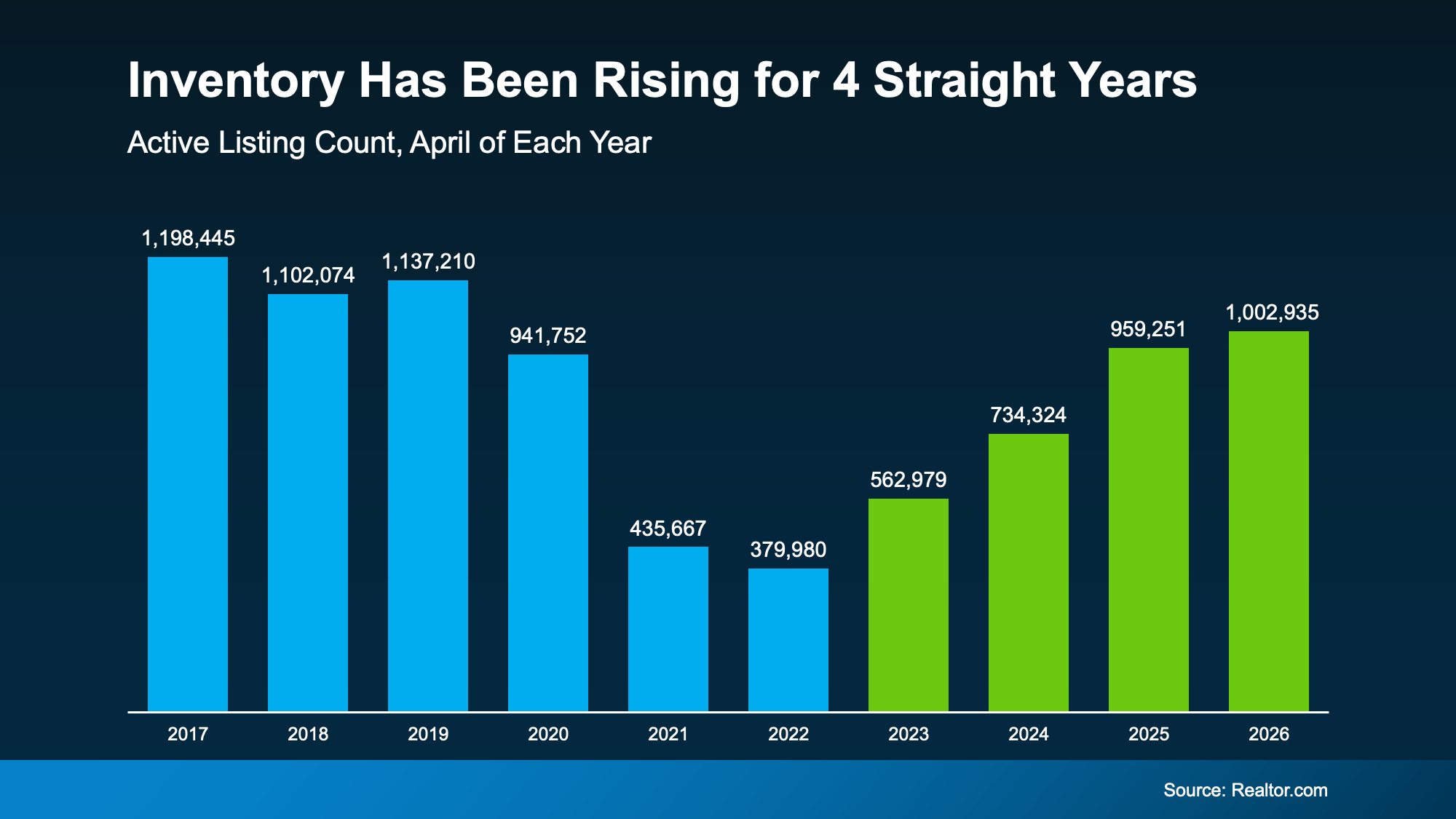
The number of homes for sale has been growing for 4 straight years (see graph below). That means more homes to choose from and, in some markets, more room to negotiate than buyers had just a few years ago. 

a graph of growth of a straight year

That doesn’t mean moving is suddenly easy. But it does mean some buyers are finding ways to make a move work. So, if you’ve been putting your plans on hold, maybe the question isn’t just:

“What’s the market doing?” or “When will it get better?”

Maybe ask yourself this, too: “Can I still live where I'm at right now and make it work?”

If the answer to that second question is “no,” it may be worth having a conversation about what your options look like today – despite where rates or prices are. You could find your move is still possible after all. With more homes for sale, there’s a better chance to find one that fits your life (and your budget) right now.

Bottom Line

Life changes. Priorities shift. Families grow. Kids move out. Careers evolve. And eventually, the house you’re in may stop fitting the life you’re living.

If that’s been weighing on you lately, let’s talk through what your options could realistically look like today, no matter where rates or prices are.

Life can’t always wait for perfect market conditions. Maybe you don’t have to either.

Posted in Home Buying
May 27, 2026

3 Things That Are Not Going To Happen in Today's Housing Market

3 Things That Are Not Going To Happen in Today's Housing Market


There’s a lot of uncertainty right now and that’s leading to some dramatic headlines. And if you’re thinking about buying a home, that can make you feel a little less sure about your decision.

A recent study by CNBC asked homebuyers what they’re most worried about, and three themes kept coming up again and again:

  • Mortgage rates
  • The number of homes for sale
  • Home prices

But a lot of what you may be hearing on those is based more on misconceptions. Not facts. So, let’s break it down and separate fact from fiction.

Misconception #1: “I’ll Just Wait, Because Mortgage Rates Are Going To Fall Dramatically”

One idea doing its rounds on social is that mortgage rates are going to drop dramatically soon. So, it’s better to wait to buy.

But is that really what’s expected?

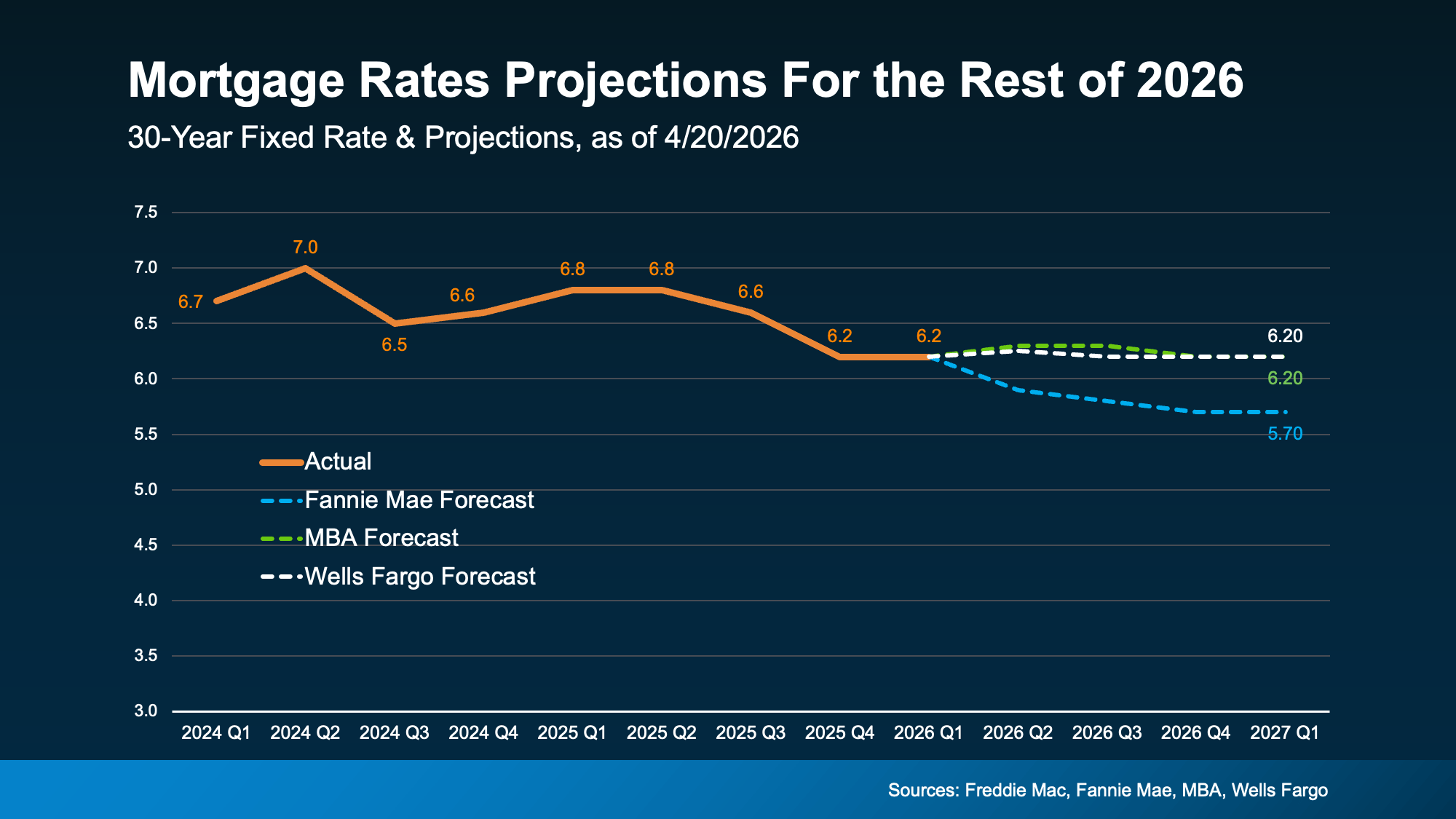
While mortgage rates have come down a bit in the last few weeks, forecasts don’t show a major drop ahead. The most likely scenario is that rates stay somewhere in the low 6% range this year. 

And that’s not a big change from where rates are now (see graph below): 

a graph with numbers and linesOf course, this depends on where inflation and the economy go from here. But, based on what we know today, waiting for a big drop in rates may not work out the way some people hope. As U.S. News explains:

“Mortgage rates aren't expected to change much over the next several quarters . . .”

Not to mention, even with rates where they are today, it’s already more affordable than a year ago. So, even if they don’t change much, it’s still better than it was.

Misconception #2: "There Are Too Many Homes for Sale Right Now”

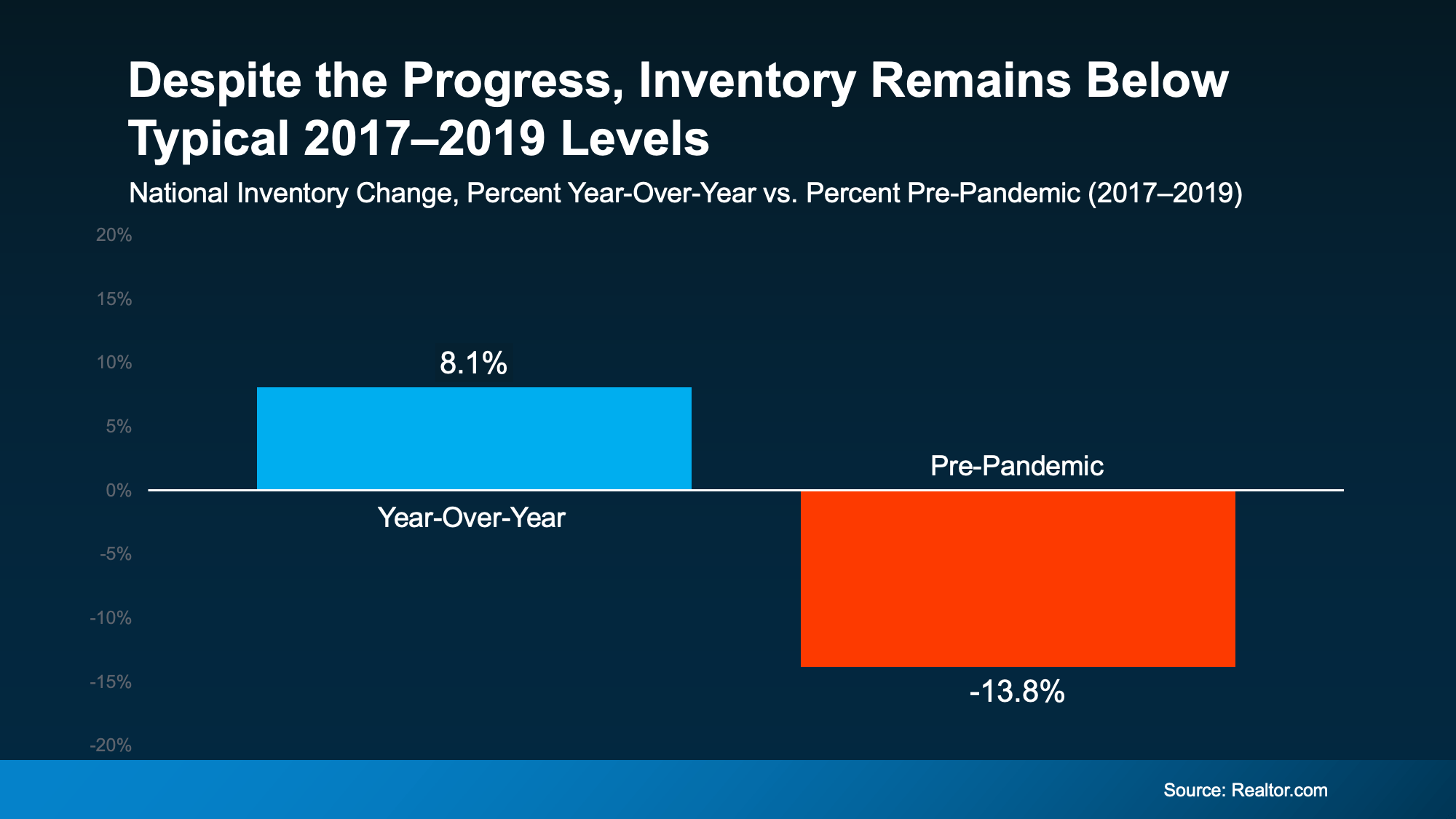
You’ve probably heard inventory is up. And nationally, it is. The number of homes for sale is 8% higher than this time last year. But that's not a bad thing. In fact, it’s one of the reasons buyers have a bit more breathing room right now.

The problem is the headlines are making something good, sound bad. They’re focusing on how this is the most inventory we’ve had since 2019 or how many homes builders are building. And that can make it sound like the number of homes for sale is rising too far, too fast.

But that’s not what the bigger picture shows.

Data from Realtor.com proves that, even though inventory is up compared to last year, it’s still nearly 14% lower than it was during the last normal housing market (2017-2019):

While it can vary a lot based on where you live, only 9 states have more inventory than pre-pandemic today. That’s a key reason why there still aren’t enough homes for sale to trigger something like the crash back in 2008.
Misconception #3: “Home Prices Are About To Crash”

You’ve probably seen this one, too. The confusion is coming from the fact that some metros are experiencing slight price declines. And influencers are running with that and saying prices are crashing. But that’s not the reality.

Most areas are seeing prices rise, not fall. And that’s because:

  • Many homeowners aren’t selling because they don’t want to give up the low mortgage rate they locked in a few years ago. And that’s keeping a lid on how much inventory can grow.
  • Since inventory is still below pre-pandemic norms, there aren’t enough homes for sale to cause a price crash.
  • And even in markets with more inventory, some sellers are choosing to pull their homes off the market instead of cutting prices.

And those are 3 big reasons prices aren’t headed for a crash. 

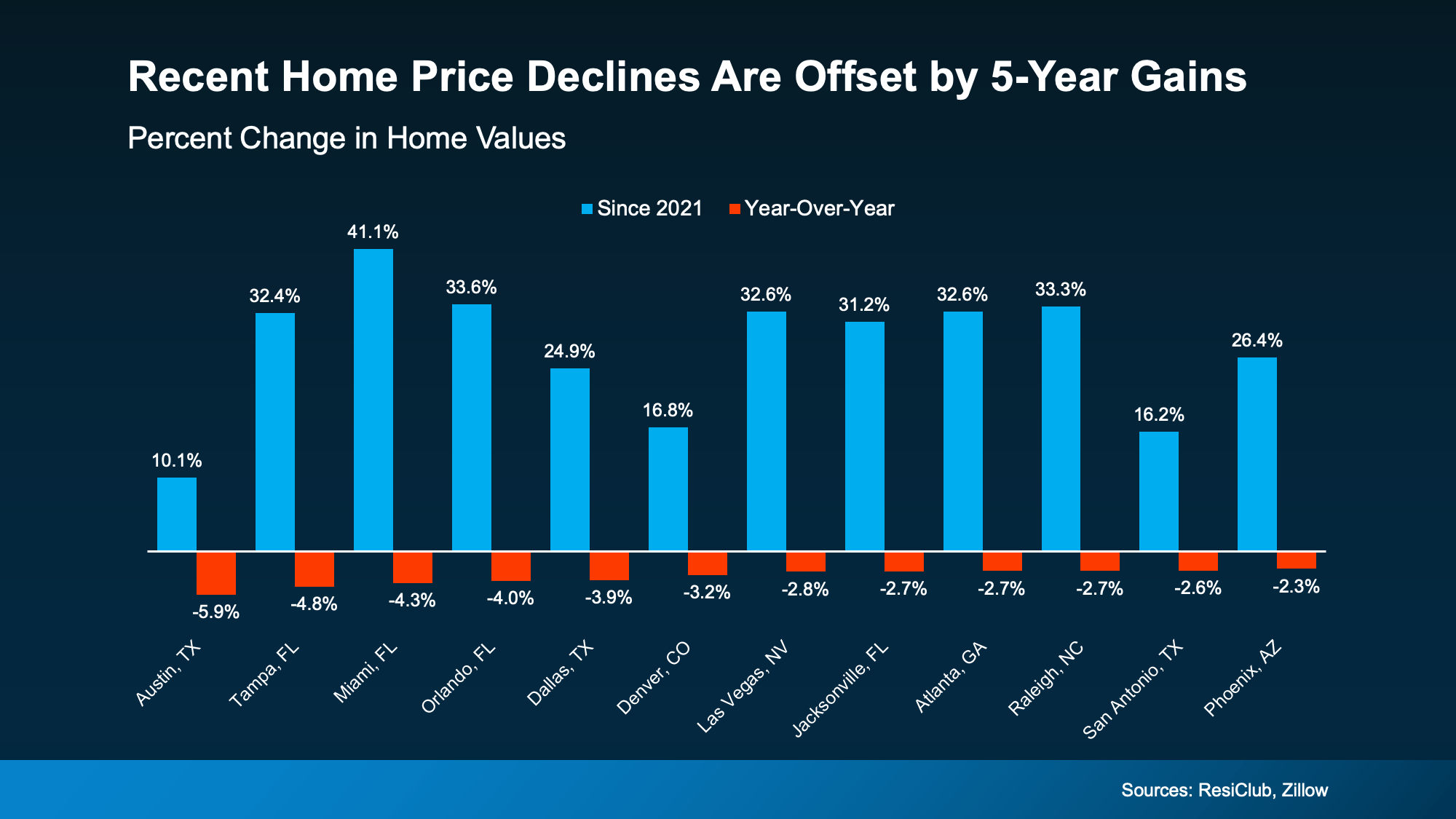
And even in the markets experiencing mild declines, the drops aren’t enough to cancel out the big gains most homeowners have seen in the last 5 years (see graph below):

That’s not a crash. That’s just prices moderating after a few record-breaking years.

Bottom Line

Online posts are going to make things sound worse than they are. If you want a true, data-bound look at what’s really happening in today’s market, lean on a real estate agent.

Let’s connect so you have someone to separate fact from fiction today.

Posted in Home Buying
May 21, 2026

Newly Built Home Prices Hit a 5-Year Low

Newly Built Home Prices Hit a 5-Year Low


If you’ve always assumed a newly built home is just not in your budget, you should know the math just got a little friendlier.

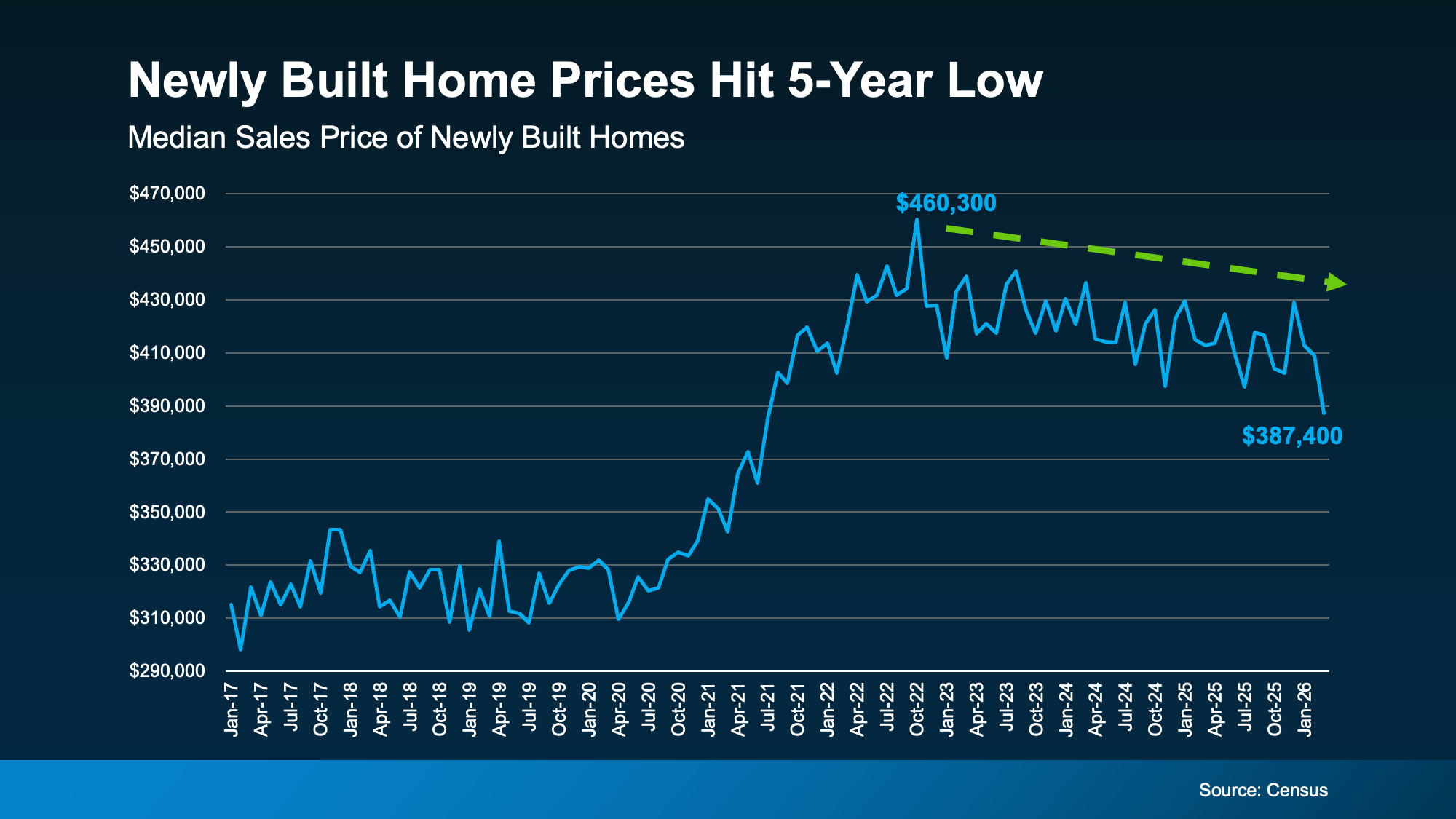
The median sale price of a newly built home is now at its lowest level since 2021, according to the latest data from the Census. And on top of that, builders are still rolling out incentives to bring buyers through the door.

Here's what's happening, and what it means if you're shopping right now.

Prices on Newly Built Homes Have Come Down

After a steep climb during the pandemic years, prices have eased a bit. The median sale price of newly built homes is sitting at about $390,000. That’s the lowest it's been in nearly five years (see graph below):

a graph of a home pricesWhile local markets vary, the national trend is moving in your favor, especially if you’re a first-time buyer. According to Zonda, prices in the entry-level price range have dropped roughly 2.7% over the past 12 months – more than any other price tier.

That doesn't mean every home in every market is suddenly affordable. But it does mean that, broadly, you’ll see the best prices on new builds since 2021, if you’re buying now.

Why This Isn’t a Repeat of 2008

And just in case you’re thinking it, lower prices don't mean the new home market is in trouble. Builders today are being intentional about how much inventory they have, so it doesn't pile up the way it did in 2008.

If you look back up at the graph, you’ll see that even after the recent improvement in new home prices, they’re still higher than pre-pandemic norms. So, this isn’t a crash. It’s a builder strategy to keep inventory moving.

Homebuilders Are Still Sweetening the Deal

Lower sticker prices aren't the only break buyers are getting. According to the National Association of Home Builders (NAHB), 60% of builders are currently offering some form of incentive to attract buyers. Those typically include:

  • Help with closing costs: Some builders are covering thousands of dollars in fees to reduce the upfront cost of buying.
  • Extra upgrades: Think premium finishes, appliance packages, and designer features, often added at no extra cost.
  • Mortgage rate buydowns: When the builder pays to lower your mortgage rate, which reduces your monthly payment.
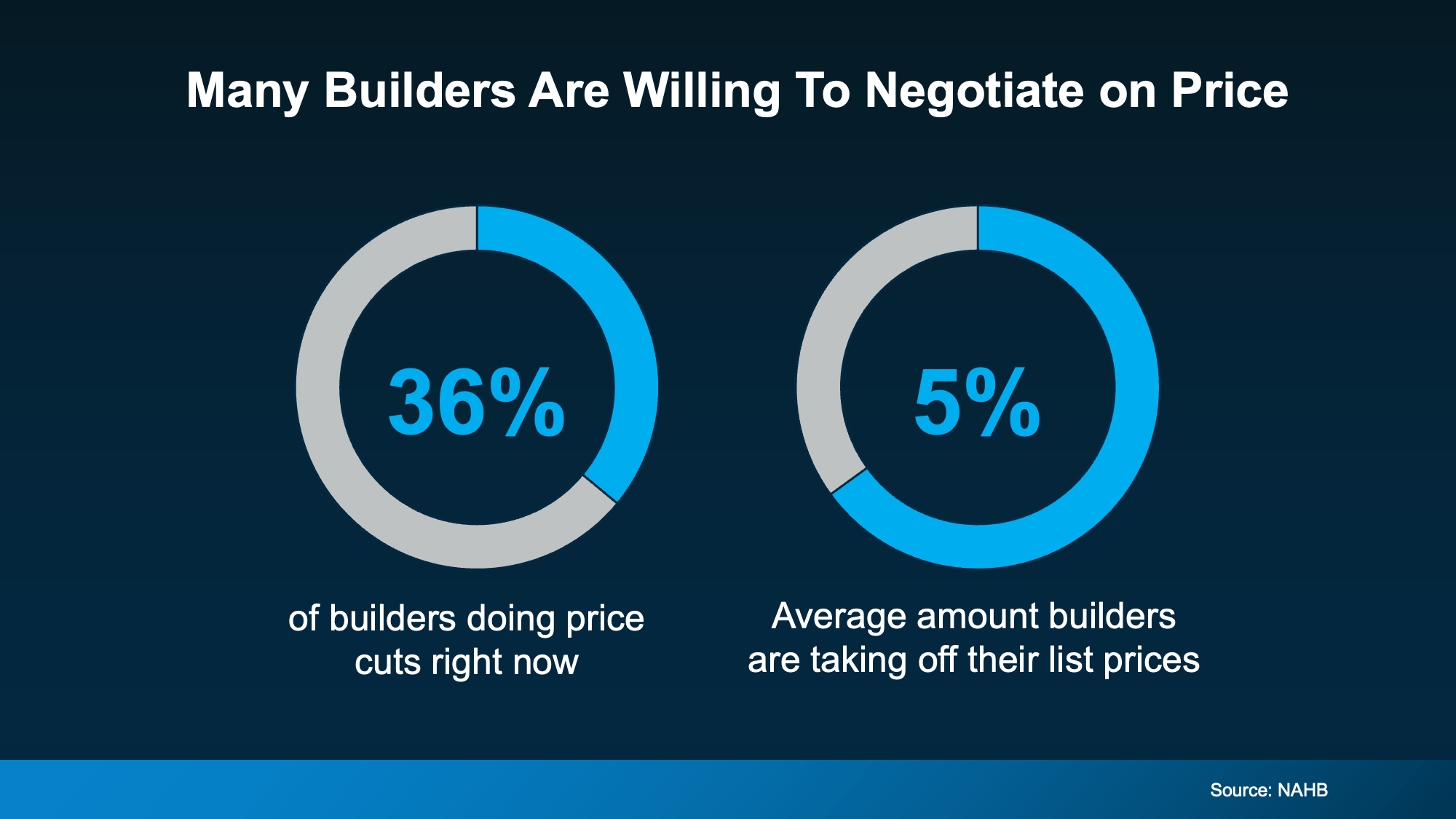
  • Price cuts: Over one in three builders (36%) are cutting prices right now, averaging about 5% off list price (see graph below):

a blue and grey pie chartThat last point catches a lot of buyers off guard – most assume that builders won’t budge on price.

But builders need to move what they've built. That's a different mindset than a homeowner deciding whether to budge on price. So, you may find they’re more open to adjusting the price than you’d think. As Joel Berner, Senior Economist at Realtor.com, puts it:

". . . many existing-home sellers resort to taking down their listing instead of taking less than their desired price, but builders are more motivated to sell their inventory than owner-occupants . . ."

And if you use the version of the graph that shows 2008 prices, you can even reference that in this explainer.

And if here, should I change the last sentence of the lede?

Bottom Line

Builder incentives and lower new home prices are working to your advantage in a way they haven't in years. Want to see what's available in your area and what kind of deal a builder may be willing to make? Let's connect.

Posted in Home Buying
May 17, 2026

Could Co-Buying Be the Answer for Some First-Time Buyers?

Could Co-Buying Be the Answer for Some First-Time Buyers?


For a lot of would-be first-time buyers, affordability is the thing that’s standing in the way. But some buyers are getting creative and finding a way to still make the numbers work – and that’s through co-buying.

The Dream Is Still Alive. The Math Just Isn’t Working for Everyone.

Young people haven’t given up on the dream of owning a home – not even close. According to FirstHome IQ, homeownership still ranks among the top life goals for the next generation.

The problem? 73% of Gen Z and millennial buyers cite affordability as the reason for not making homeownership a priority. And it shows. First-time buyers now make up just 21% of all home purchases, the lowest share since the National Association of Realtors (NAR) started tracking the data in 1981.

But still, some buyers are making it happen. And a portion of them are turning to co-buying to get their foot in the door.

So, What’s Co-Buying?

Co-buying means purchasing a home with someone else, like a friend, sibling, or unmarried partner. You combine incomes, split the down payment, and share monthly costs. For some people, it’s a creative way to turn “someday” into a concrete move-in date that’s just around the corner.

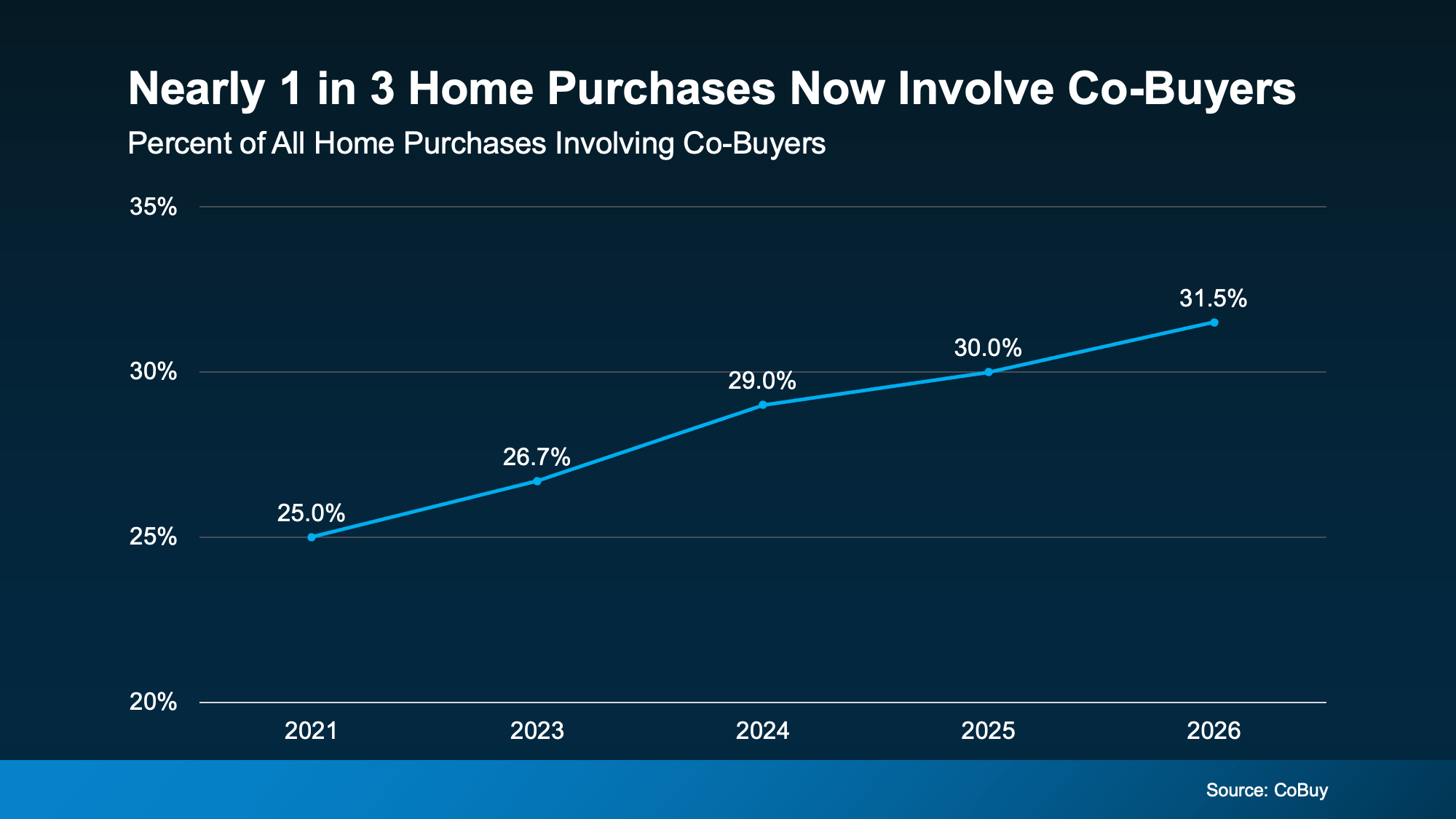
And it's catching on fast, just look at where things stand today. According to CoBuy.io, 64 million Americans now co-own a home with someone they’re not married to. In fact, 31.5% of home purchases involve co-buyers (see graph below):

Why It Works

Here are just a few of the top reasons buyers are going this route, according to NerdWallet:

  • Quicker path to homeownership: If owning a home is a serious goal for you, buying with someone else can help make that reality on a shorter timeline. Two or more people can save up a down payment a lot faster than one. That’s less time waiting and more time building equity in a place that’s yours.

  • More purchasing power: With multiple incomes going toward the home purchase, you might be able to afford a nicer home or live in a more popular neighborhood. Sometimes teaming up means getting the home you actually want, not just the one you can barely afford on your own.

  • Easier loan qualification: Added income from more than one buyer can also help with your debt-to-income (DTI) ratio, which the lender will calculate based on all the borrowers.

  • Lower housing costs: Splitting up a mortgage payment multiple ways could maybe even make owning less expensive than renting. Plus, sharing costs can make repairs or renovations more manageable, too.

Things To Keep in Mind

If you’re considering going this route, there are some things you’ll want to think over. For starters, co-buying works best with people you trust and share financial goals with. So, before moving forward, make sure everyone agrees on how costs are split, who handles what, and what happens if one person wants to sell down the road.

That’s why a written co-ownership agreement can be a smart move. It keeps everyone on the same page and helps avoid headaches down the line. Think of it less like a legal formality and more like a game plan for your new investment.

Bottom Line

Affordability challenges are real, but they don't have to mean waiting indefinitely. Co-buying is helping some first-time buyers stop waiting and start putting down roots.

If you're curious whether it could work for your situation, let's talk. Reach out today and let's figure out your path to homeownership together.

Posted in Home Buying
April 20, 2026

The 10 Best Markets for First-Time Buyers This Spring

The 10 Best Markets for First-Time Buyers This Spring


For a while, buying your first home hasn’t just felt hard. It may have felt out of reach.

Not because you weren’t ready.

Not because you weren’t trying.

But because every time you ran the numbers, they didn’t work.

That’s why so many first-time buyers stepped back.

But after years of sitting on the outside looking in, this Spring could give buyers like you an opening again – especially in some markets.

Metros Where Buyers May Have an Easier Time Breaking into the Market 

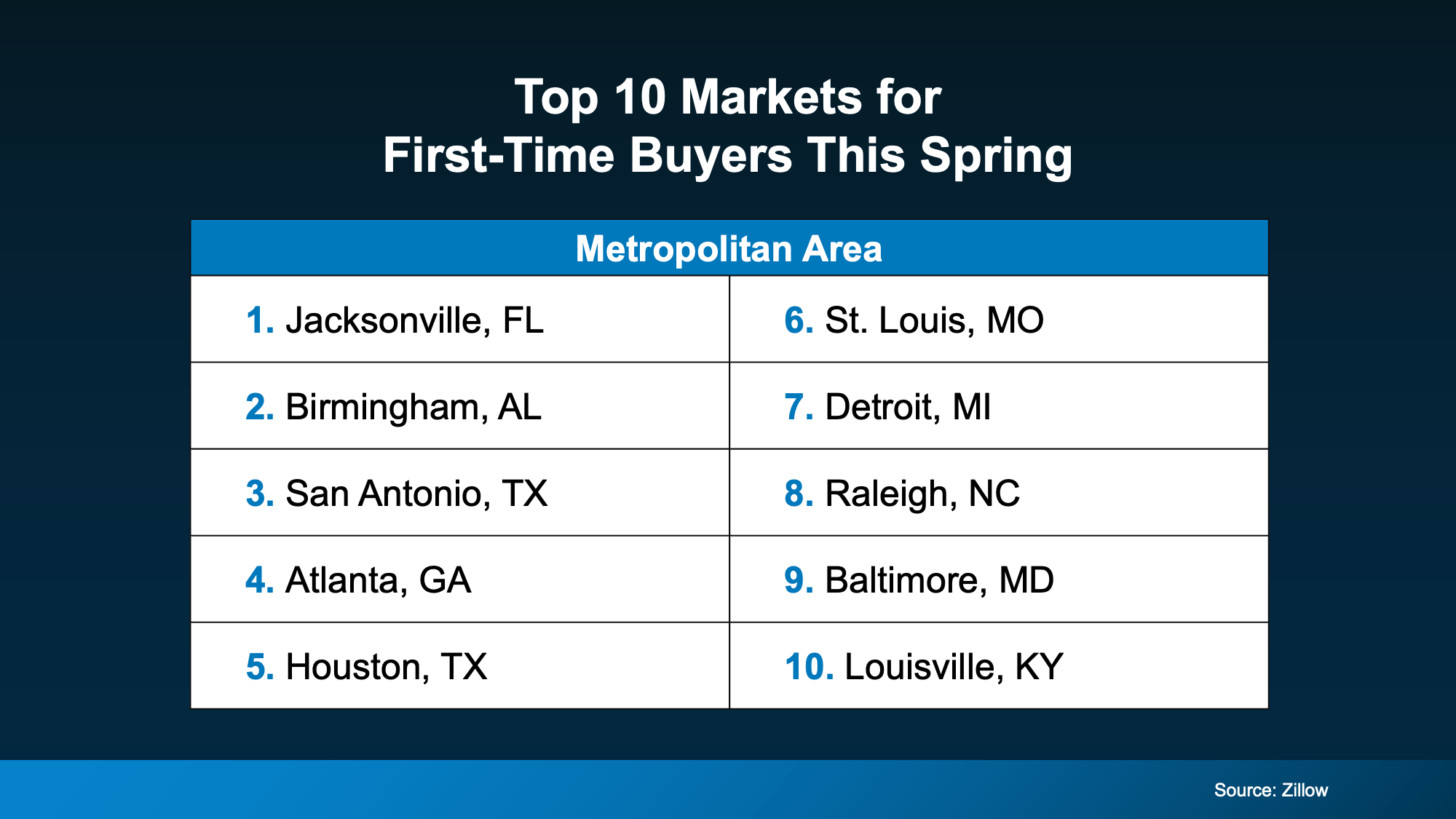
Zillow just released a list of the top 50 metros for first-time buyers this Spring. And here’s a quick snapshot of the top 10 (see chart below): 

a table with white text and black text

According to Zillow, in these top-ranked markets, median-income households can afford 68% of all homes for sale. Let that sink in.

Not long ago, it felt like you could barely afford anything.

Now, you may actually have some options again.

That doesn’t mean every home is suddenly going to fit your budget. But it does mean the door that felt closed for so many buyers is starting to crack back open. And in a number of cities, first-time buyers may finally be getting a shot at buying.

Why This Is Starting To Open Up

These cities are rising to the top not because of any one big change, but from a few smaller ones finally lining up. As Orphe Divounguy, Senior Economist at Zillow, explains:

First-time buyers are finally seeing some light at the end of the tunnel. Affordability is still a challenge, but rising incomes, stabilizing prices and improving inventory are creating real opportunities in parts of the country. In the strongest markets for first-time buyers, they'll find more choices, less competition and a clearer path to homeownership than they've had in years.”

Basically, three big things are working in your favor:

  • More homes are hitting the market. Realtor.com says inventory is up 8.1% compared to last year. That gives you more choices, less pressure, and more chances to find a place that fits your budget.

  • Price growth is moderating, so homes aren’t moving further out of reach as quickly. Some may even be falling back within your target price point.

  • Incomes are rising. If you make more money, that can offset some of the affordability challenges too.

And even though mortgage rates have been higher lately, that combination can still make a difference. As Mark Fleming, Chief Economist at First American, explains:

“Income growth has outpaced house price growth for 19 straight months, boosting house-buying power even as mortgage rates remain elevated.”

How To Find the Opportunities in Your Local Market

But what if your city didn’t make the top 10 list, or even the top 50 markets? Here’s what you really need to remember.

There’s going to be opportunities in every market, if you know where to look.

Even in the same city, two buyers can have completely different experiences. And a big part of that is who they choose as their partner. The right agent knows how to find pockets of opportunity in any market. That could mean:

  • A neighborhood where prices haven’t climbed as quickly

  • A part of town with more inventory, or

  • A new build community offering incentives so builders can sell their inventory

So, even if your city didn’t make the list, that’s okay. There’s still an opening for you, you just need your agent to help you find it.

Bottom Line

For a long time, first-time buyers have felt stuck, waiting for their turn to buy. But for some buyers, this Spring might be the first time in a while where things start to feel more within reach again.

Want to see which neighborhoods could give you the best shot at buying right now? Let’s talk.

Posted in Home Buying
April 15, 2026

Getting a Tax Refund? Here’s How It Can Help You Buy a Home

Getting a Tax Refund? Here’s How It Can Help You Buy a Home


If you’re getting a tax refund this year, here’s something worth thinking about. That money could actually help you get closer to buying a home.

It may not be something you’ve factored into your plan yet, but it can give your savings a nice boost right when you need it most. And whether your refund is a few thousand dollars or more, there are some smart ways to put that money to work as you get ready to buy.

Your Refund May Be Even Bigger This Year

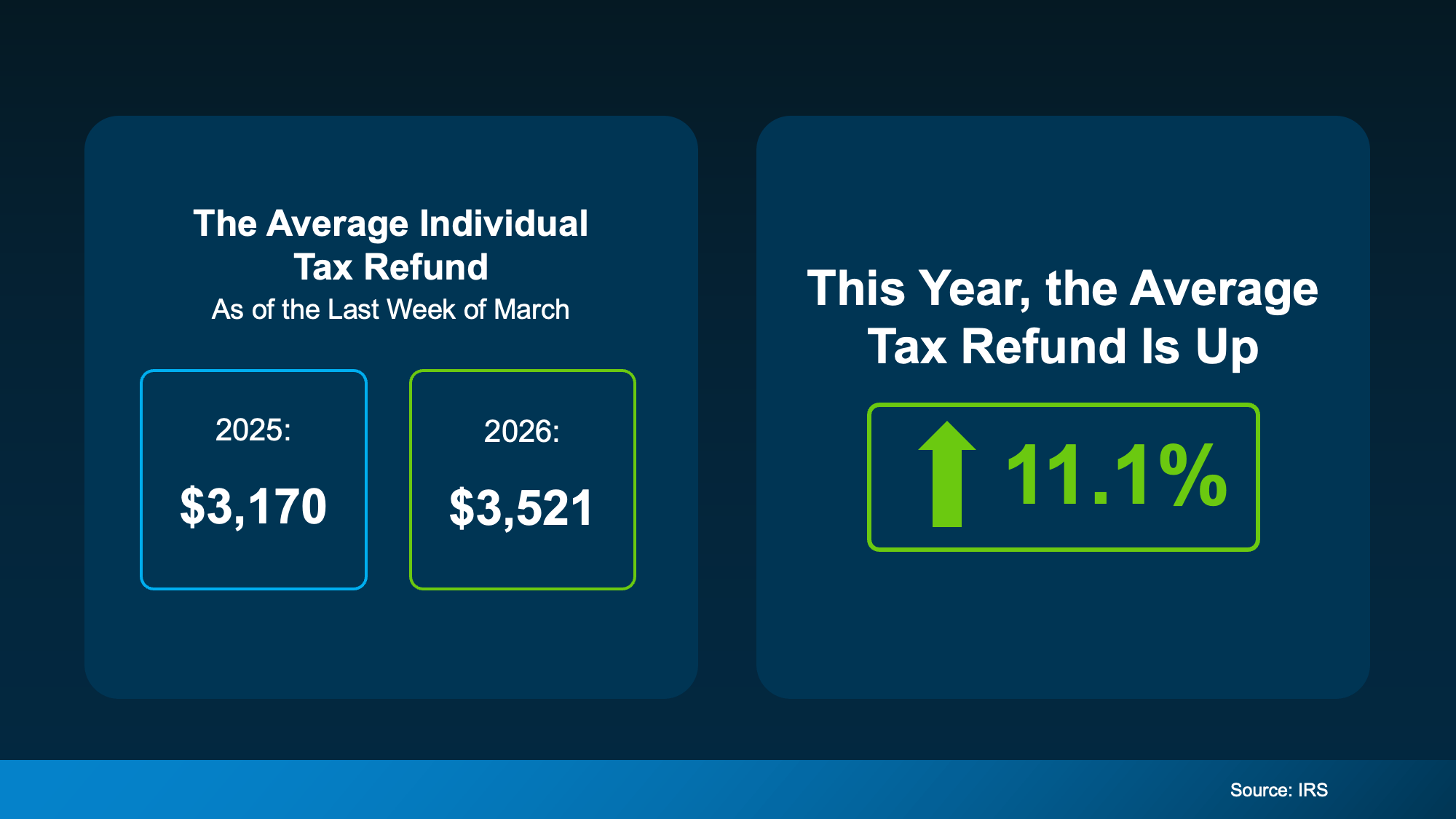
Let’s start with the good news. People are getting even more money back in their refunds than they did last year. The visual below uses data from the Internal Revenue Service (IRS) to show the average individual’s refund is 11.1% higher this year:

a screenshot of a computerOf course, your exact refund will vary. But any extra money you get is a good thing, especially when affordability is still tight. 

How You Can Use Your Tax Refund

So, how can you put that money to work? Here are a few smart ways to use your refund when buying a home, according to Freddie Mac:

  • Put it toward your down payment. Data shows saving for a down payment is one of the biggest hurdles for first-time homebuyers. Using your refund can help you build that up faster. And the good news? You may not need to put as much down as you think.
  • Use it for your closing costs. Closing costs usually range from about 2% to 5% of the home’s purchase price. Using your refund here can make things feel a lot more manageable on closing day.
  • Lower your mortgage rate. You may have the option to buy down your mortgage rate. That means paying a little more upfront to get a lower monthly payment. If you’re looking for ways to make the numbers work a little better, this is something that could be worth asking about.

You Don’t Have To Figure This Out Alone

If you have a tax refund coming, it’s a great time to take another look at your homebuying savings. Maybe you’re almost at your goal and you can buy sooner than you expected.

A trusted real estate agent and lender can help you map out what you need, what your options are, and how to make the most of what you already have, including your tax refund.

Bottom Line

If buying a home is on your radar this year, don’t overlook your tax refund. It could be the extra push that helps you go from almost there to actually ready.

Want to see how far your savings could take you right now? Let’s talk and build a plan that fits your situation.

Posted in Home Selling
April 8, 2026

Thinking About an Adjustable-Rate Mortgage? Here’s What You Need To Know.

Thinking About an Adjustable-Rate Mortgage? Here’s What You Need To Know.


If you’ve been looking for a home lately, you’ve probably felt how tough affordability still is. And that's exactly why more buyers are opting for adjustable-rate mortgages, or ARMs.

Here's what you need to understand about how they work, and whether they make sense for you.

What Is an Adjustable-Rate Mortgage?

Since a lot of people aren’t familiar with this type of loan, let’s start with a definition. This is how Business Insider explains the main difference between a fixed-rate mortgage and an adjustable-rate mortgage:

“With a fixed-rate mortgage, your interest rate remains the same for the entire time you have the loan. This keeps your monthly payment the same for years . . . adjustable-rate mortgages work differently. You’ll start off with the same rate for a few years, but after that, your rate can change periodically. This means that if average rates have gone up, your mortgage payment will increase. If they’ve gone down, your payment will decrease.”

Basically, one doesn’t change much over the life of your loan.

And one could change... either by a little, or a lot.

Of course, things like taxes or homeowner’s insurance can still have an impact on a fixed-rate loan, but the baseline of your mortgage payment is fairly steady. But the big difference is that with an ARM, your monthly payment could change over time.

Why Adjustable-Rate Mortgages Are Getting More Attention

So, why do some buyers choose this option? It's simple. It’s because of the upfront savings. Business Insider explains it like this:

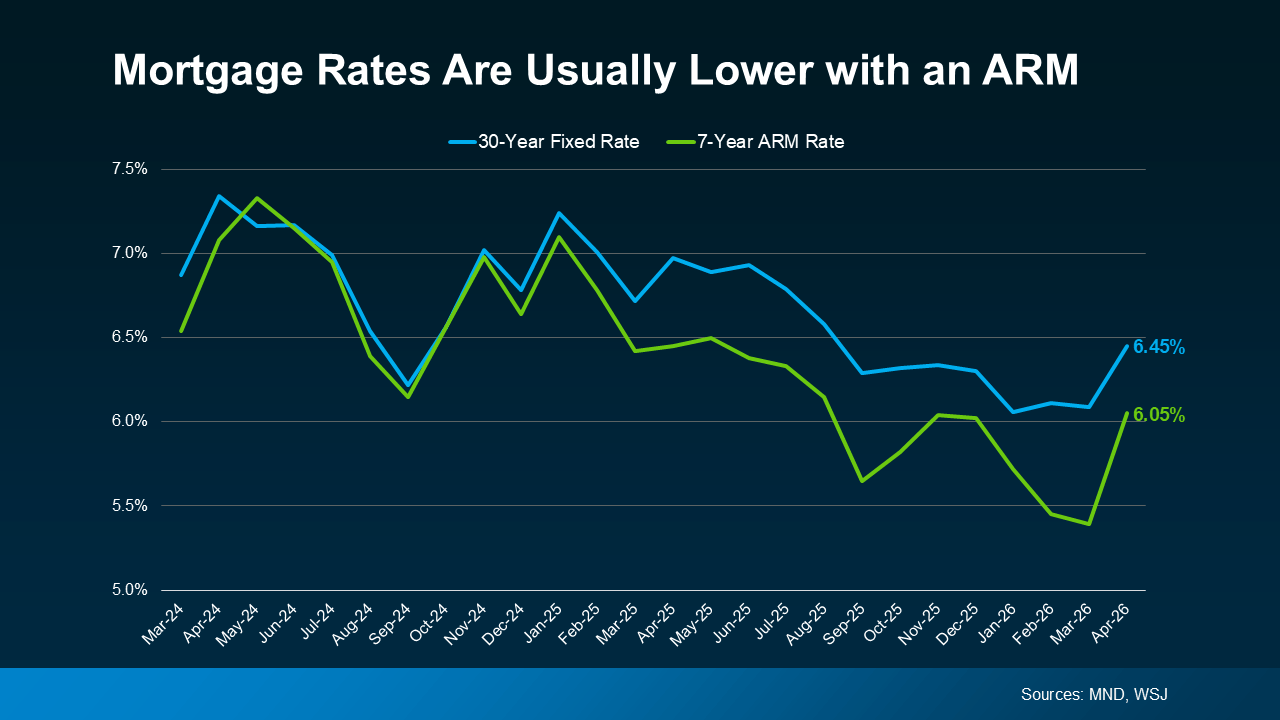
“Because ARM rates are typically lower than fixed mortgage rates, they can help buyers find affordability when rates are high. With a lower ARM rate, you can get a smaller monthly payment or afford more house than you could with a fixed-rate loan.

And right now, according to Mortgage News Daily and the Wall Street Journal, the upfront rate on an ARM is lower than a 30-year fixed mortgage (see graph below):

a graph with green and blue linesIf you’re wondering how that shakes out in real dollars and cents, here’s what Redfin says. According to their research, the typical buyer could save about $150 per month by taking out an ARM instead of a 30-year fixed mortgage.
For some people, that’s enough to make a difference.

More Buyers Are Choosing Adjustable-Rate Mortgages Today

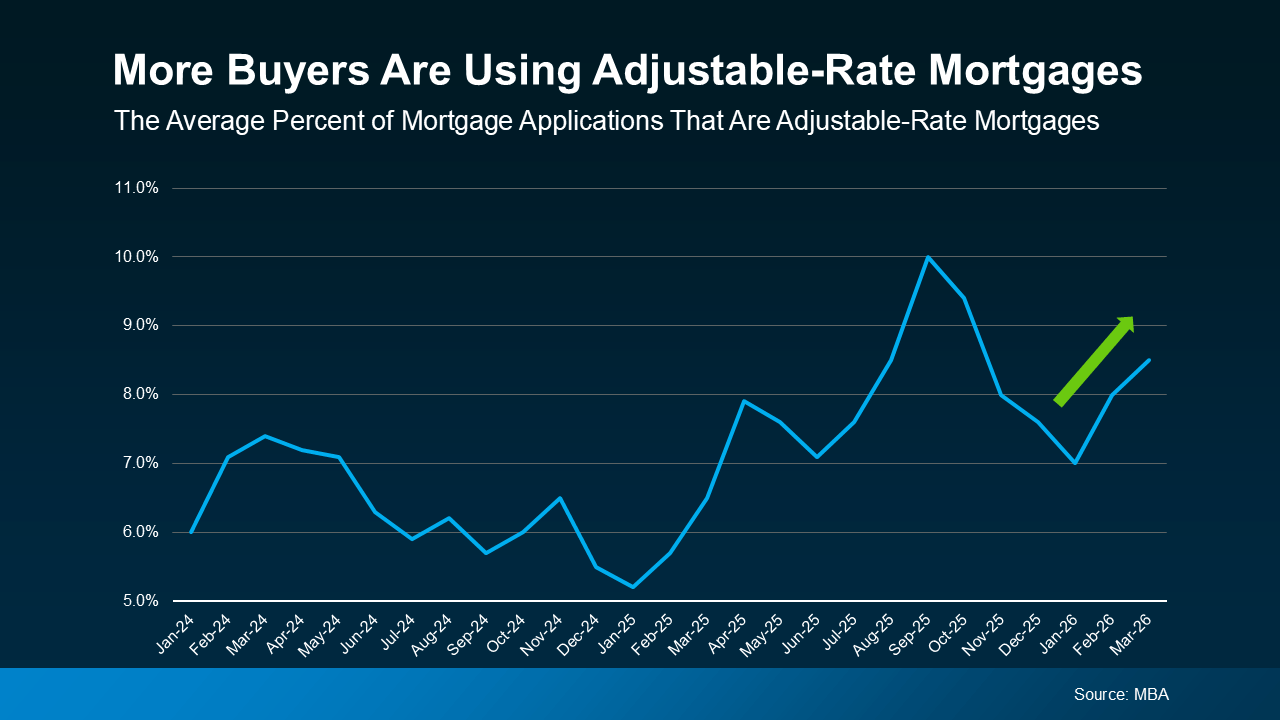
A growing number of buyers are willing to trade the uncertainty later for a lower payment now. Data from the Mortgage Bankers Association (MBA) shows the share of buyers choosing ARMs has increased, especially over the last few years (see graph below).

This doesn’t mean ARMs are becoming the go-to option for everyone. It only means some buyers are opting for this type of mortgage, so they can still buy today.

a graph with a line going upAnd if you remember the housing crash, seeing ARMs gain popularity again may raise concerns. But rest easy. Today’s ARMs aren’t the same.

Back then, some buyers were given loans they couldn’t afford once rates adjusted.

Today, lending standards are stricter, and lenders evaluate whether borrowers could still handle the payment if rates rise. So, the return of ARMs doesn’t signal another widespread crash. It just reflects how some buyers are adapting to today’s affordability challenges.

The Trade-Off – What You Need To Consider

If you’re considering an adjustable-rate mortgage yourself, just remember it really all depends on your situation and your risk tolerance.

An ARM may make sense if you plan to move before your rate would adjust or if you expect you’ll make a higher income in the future. But there are trade-offs you need to think through.

For example, once the fixed period ends, your rate can adjust, and your payment could increase, potentially by a meaningful amount depending on where rates are at that time.

And keep in mind, there’s also no guarantee mortgage rates will come down in the future, which means refinancing later isn’t always an option. That’s why it’s important to think through your plan, understand your long-term earning potential, and work closely with a trusted lender before you choose an ARM.

Bottom Line

ARMs are getting more attention again because they can make buying a home more affordable in the short term. But they’re not right for everyone.

The key is understanding how they work, what the risks are, and whether they fit your plan. And that’s why you need to talk to a trusted lender and financial advisor before you make any decisions.

Posted in Home Selling
March 25, 2026

You Can’t Control What’s Happening with Mortgage Rates. But You Can Control This.

You Can’t Control What’s Happening with Mortgage Rates. But You Can Control This.


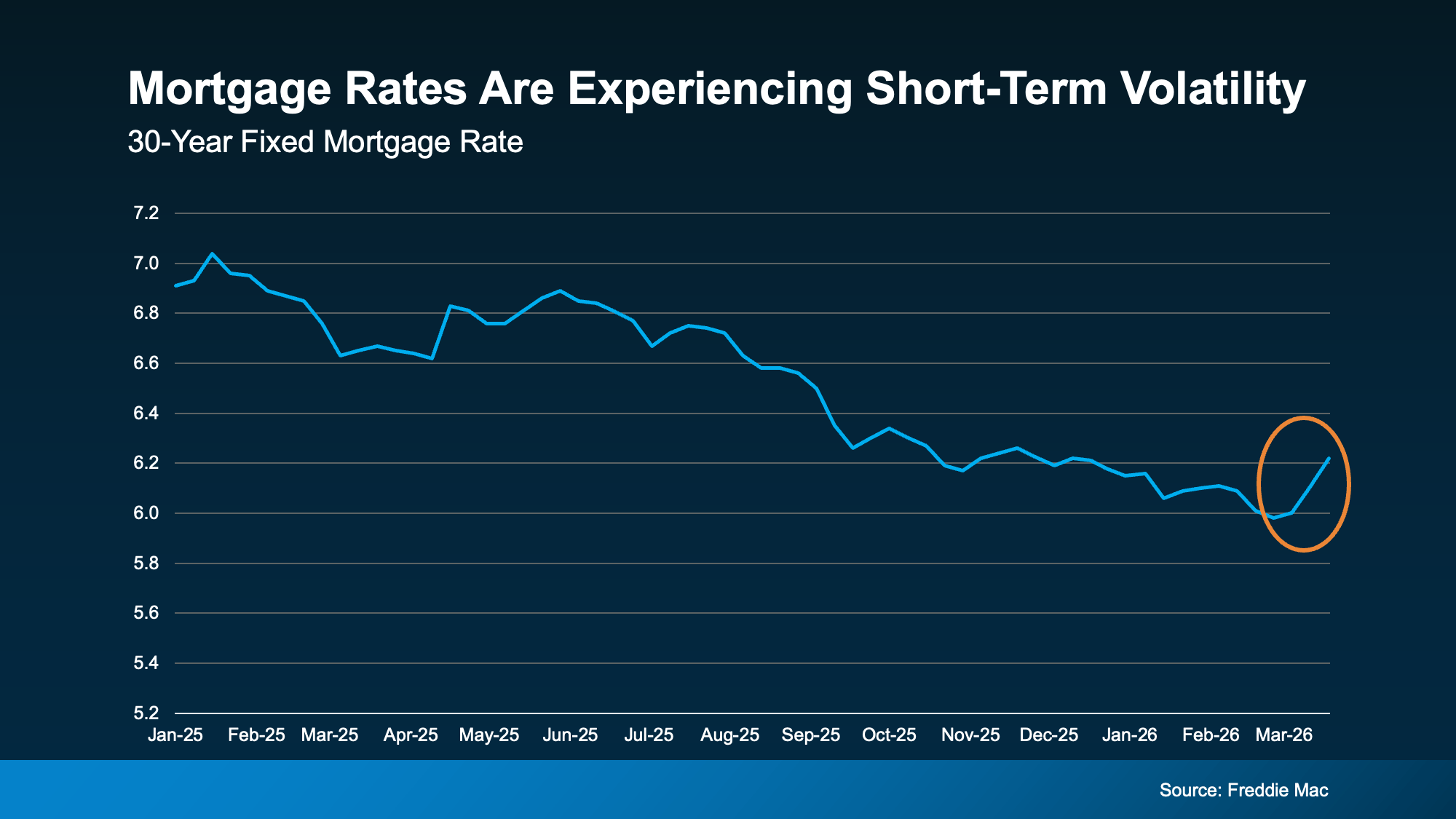
Mortgage rates have been volatile lately. And if you’re thinking about buying a home, that can make it harder to plan. But there are still things you can do to get the best rate possible in today’s market. It starts with having the right information.

So, what’s causing the bumps in rates? And what can you do about it? Let’s break it down.

Mortgage Rate Volatility Is Normal

Data from Freddie Mac shows the recent volatility. After trending down for well over a year, there was a rise this month (see graph below): 

a graph showing a line of a moving rate

While it’s easy to be distracted by the changes, here’s what you need to remember.

It’s normal for rates to bounce around a bit here and there. For example, if you look back at the graph, you’ll see that even within the past year there have been times like this when rates inched up. We’re in one of those moments right now and you need to be aware of that.

Especially when there’s economic uncertainty or big global events happening, volatility like this is expected. As Investopedia explains:

“Mortgage rates don’t move in isolation. When global events inject uncertainty into financial markets . . . that can ripple through to borrowing . . . mortgage costs can respond quickly to geopolitical developments. As long as uncertainty remains elevated, rate swings may continue.”

And that’s one of the reasons why trying to time the market isn’t a wise move.

You can’t control what happens with mortgage rates. But there are still things you can do to help you get the best rate possible in today’s market. And here’s where to focus your effort.

Your Credit Score

Your credit score plays a big role in the rate you qualify for. Even a small improvement can make a noticeable difference in your monthly payment. As Bankrate puts it:

“Your credit score is one of the most important factors lenders consider when you apply for a mortgage. Not just to qualify for the loan itself, but for the conditions: Typically, the higher your score, the lower the interest rates and better terms you’ll qualify for.”

So, make sure you do what you can to keep your credit score up. If you’re not sure what your score is or how you can improve it, talk to a trusted loan officer.

Your Loan Type

There are also different types of home loans – and each one can have unique requirements, benefits, and rates for qualified buyers. The Consumer Financial Protection Bureau (CFPB) explains:

“There are several broad categories of mortgage loans, such as conventional, FHA, USDA, and VA loans. Lenders decide which products to offer, and loan types have different eligibility requirements. Rates can be significantly different depending on what loan type you choose.

That’s why it’s so important to explore your options with a lender. You may even want to talk to multiple lenders to see how the options vary.

Your Loan Term

The length of your loan matters too. Most lenders typically offer 15, 20, or 30-year loans. Freddie Mac offers this advice:

“When choosing the right home loan for you, it’s important to consider the loan term, which is the length of time it will take you to repay your loan before you fully own your home. Your loan term will affect your interest rate, monthly payment, and the total amount of interest you will pay over the life of the loan.

Again, to figure out what makes the most sense for your budget and long-term goals, have a lender walk you through all your options.

Bottom Line

Thinking about buying right now? The best advice is to accept that you can’t control where rates are going to go from here.

What you can do is work with a trusted lender and take steps that’ll help you get the best rate possible.

So, if you want to move today, let's make it happen. We just need to control the controllables and focus where it counts.

Posted in Home Buying